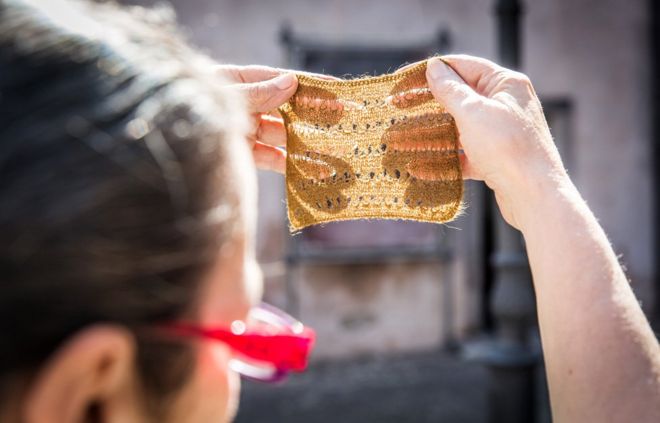
Chiara Vigo is the only woman in the world who still works the byssus, better known as the silk of the sea, the same way women in ancient Mesopotamia used to weave it in order to make clothes for their kings. PHOTO: BBC
The Italian island of Sardinia. A place where coastal drives thrill, prehistory puzzles, endearing eccentricities exist. As DH Lawrence so succinctly put it: ‘Sardinia is different.’ The island has been polished like a pebble by the waves of its history and heritage. And an indispensable part of it is Chiara Vigo, who is thought to be the only women left who can harvest sea silk, spin it and make it shine like gold. By her own admission, Vigo is neither an artist nor an artisan. She is a master. While an artist creates over inspiration and an artisan produces and sells, masters pass their art on. Like she hopes to.
The byssus is a fine fabric produced from the velvety strand of the noble pen shell, or pinna nobilis, an endangered fan-shaped species of mollusc, native of the Mediterranean Sea bed. Originally, the pen shell used to be fished in order to pull the byssus out, but Chiara has come up with a special cut so that she can take the secreted material without killing the precious animal.
“The pen shell offers us ten centimeters of byssus per year,” explained Chiara, who dives herself on the lookout for the rare silk. “To gather 200 grams of byssus, I need to go on 300 divings,” she revealed, pointing out to me that “it doesn’t grow on the bottom of the shell, like many people think, but right here, on the side.”
After collecting the byssus, the first step is to leave the raw material to soak in a mixture of eight seaweeds. Once dry, Chiara combs it with a wool card and finally twists the fine filaments together with a spindle made of oleander, forming the gilded thread. The yarn is spun quite a few times in order to make it strong enough to be employed in the loom and woven with her slender fingers.
Vigo’s father died when she was eight and her mother was an obstetrician who mostly worked away from home, so much of the time she was looked after by her grandmother – and it was her grandmother who taught her the art of working and embroidering with byssus. She in turn had learned it from her own mother, and so on, back through the generations.
“Weaving the sea silk is what my family has been doing for centuries,” Vigo says. “The most important thread, for my family, was the thread of their history, their tradition.”
The sign on the door says, it is not for sale. “It would be like commercialising the flight of an eagle,” Vigo says.
“The byssus is the soul of the sea… it is sacred.”
Read more about the history of sea silk here while the BBC brings you more on Vigo,
 Organikos