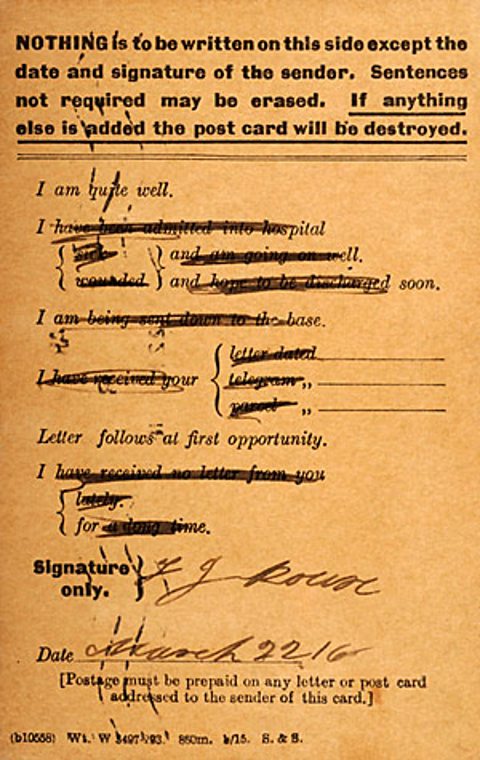
A completed field postcard, posted on 22 March 1916. PHOTO: BBC
When was the last time you put paper to pen and saw your writing come to life? The last time you held a piece of card so small but held news and feelings from across seven seas? Writing and receiving mail is quite the experience, all the more now in the age of keypads and instant messages. It was important, too. Like in the time of the World War. When the mail was recognized as the biggest tool of maintaining morale.
BBC brings some interesting facets:
The most effective weapon used during World War One wasn’t the shell or the tank, it was morale. The British Army believed that it was crucial to an allied victory, and it looked to the Post Office for help.
The delivery of post was vital for two reasons. Firstly, receiving well wishes and gifts from home was one of the few comforts a soldier had on the Western Front. The majority of them spent more time fighting boredom than they did the enemy, and writing was one of the few hobbies available to them. For some, it was a welcome distraction from the horrors of the trenches.
Secondly, letters served a propaganda purpose as everything that soldiers sent back was subject to censorship. The British Army claimed this was to prevent the enemy finding out secret information, but really it was to prevent bad news from reaching the home front. Letters from serving soldiers had a powerful role, not just in keeping families informed of the well-being of their loved ones; they also helped to sustain popular support for the war across the home front. Nothing could be allowed to jeopardise that.
The British Army took a number of proactive measures to censor what information made it home from the trenches.
However, censorship was crude. Forbidden subjects were either ripped out of letters or simply scribbled out. In some cases the censored words remained readable.
Field postcard
One method of censorship was the field postcard. These printed cards gave soldiers a number of multiple choice options which they could cross out if they weren’t relevant. They were not allowed to write messages on them.
Honour envelope
Another, more subdued, form of censorship was the honour envelope. These required the sender to sign a declaration to say that they hadn’t disclosed any forbidden information. That way, their letters would only be read by postal workers on the home front instead of by their superiors in the trenches.
Self-censorship
While the field postcard and the honour envelope achieved their purpose, the greatest acts of censorship were actually carried out by soldiers themselves. Many fighting men were keen to hide the realities of war from their loved ones back at home in their letters and simply left out much of what they really went through.
Read more here.
 Organikos