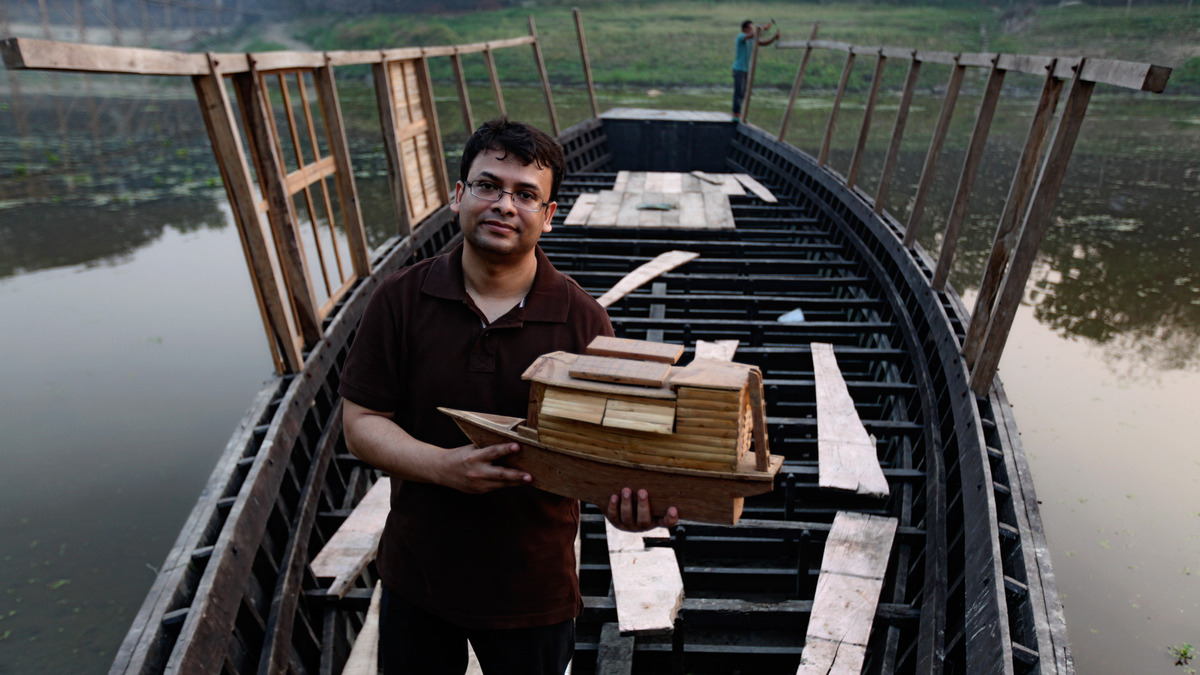
Architect Rezwan’s idea is to combine a school bus with the schoolhouse, and use the traditional wooden boat to create a floating space to bring primary education to doorsteps. PHOTO: ABIR ABDULLAH/ SHIDHULAI SWANIRVAR SANGSTHA
Bangladesh is prone to flooding due to being situated on the Ganges Delta and the many distributaries flowing into the Bay of Bengal. Coastal flooding, combined with the bursting of river banks is common, and severely affects the landscape and society of Bangladesh. 75% of Bangladesh is less than 10m above sea level and 80% is floodplain, therefore rendering the nation very much at risk of periodic widespread damage, despite its development. One man, who as a child often found himself cut off from school, did not want the future generations to face the same plight.
His idea: using boats to facilitate education at the time of floods.
Growing up in rural Northwest Bangladesh, Mohammed Rezwan witnessed decades of increasingly violent weather events, including dozens of monsoons and a 1991 cyclone that killed 138,000 people. Though his family owned a small transportation boat that allowed him to attend some classes during rain season, Rezwan’s friends and relatives weren’t so lucky. During monsoon season, he says, they couldn’t attend school, leaving many of them deprived of an elementary education.
“It was frustrating and difficult for me to accept this situation,” he says.
In 1998, after graduating with a degree in architecture from a university in Dhaka, Bangladesh’s capital, Rezwan returned to the small village where he grew up and set out to devise a solution to the floods destroying Bangladesh’s education.
“Architects build houses or buildings for those who have the ability to construct them, but why can’t architecture do wonderful things for poorer people in their communities? I wanted to do something for the communities where I grew up,” he says.
When he built Shidhulai’s first ship, Rezwan aimed to ensure the boat would remain a local project, in both form and function. He would source wood from native shala trees and metal from local vendors, and hire village residents to convert flat-bottomed river boats into 55-foot long school boats held together by metal beams and waterproof roof and floors made from shala — all of which would be monsoon-resistant.
Because so many Bangladeshi children work during the day, Shidhulai installed solar panels on the boat’s roof so it would have electricity in the evening for night students.
“I wanted it to have a cultural-friendly design that helps people create ownership into project,” Rezwan says. “The boats are built with local knowledge and villagers provide the labor and materials.”
The school-boat collects children from various villages, then it docks and class begins.
Each day, the Shidhulai school starts out as a water taxi, picking up students at a group of stations and docking at the last stop, where the 30 or so pupils begin their school day on the boat.
In addition to attending three primary education classes, Shidhulai students also learn about protecting the environment and conserving water and energy.
“We want children to share this with their community,” Rezwan says.

 Organikos