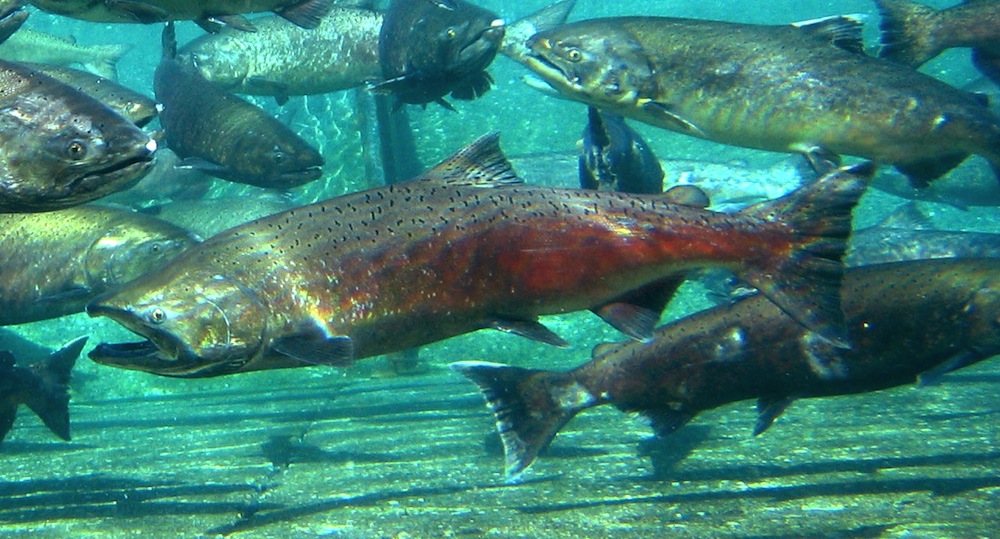
Drought and man-made obstacles lead fishery to boost releases of Chinook into Sacramento River, in hopes that a few thousand return to spawn. PHOTO: Livescience
To boost the dwindling population of natural chinook salmon in California, hundreds of thousands of fish are spawned and released by federal and state agencies every year. This year, 600,000 salmon were released earlier than normal because of a historic drought in California.
The California drought, the state’s worst on record, has taken a terrible toll on those already-diminished winter Chinook salmon runs. It’s not just that there isn’t enough water; there’s not enough cold water, especially after competing interests such as urban areas and big agriculture—each equipped with more political muscle than wild salmon advocates have—take their share. In 2014, the returning winter Chinook numbers were the worst that fishery officials had ever seen. In a normal year, about 25 percent of the eggs produce baby salmon healthy enough to migrate; last year, with only 5 percent surviving their infancy in the unusually warm water, nearly the whole winter run was wiped out.
National Geographic brings you details on how a dedicated team works to overcome barriers that stands in the way of salmon migration:
Here’s how the miracle begins, when things are going as they’re supposed to in the wild: The baby Chinook, one of the five main salmon varieties in the West, hatches from an egg that its fish parents buried in the gravel of a cold-water river before they perished. The cold part is crucial; the water’s got to stay below about 60°F (15.5°C).
When the first mystery cue comes—Time to go!—the now-juveniles prepare not only to leave home, but also to change into saltwater fish. Even at tremendous distance, biologists say, they can somehow sense the sea. Theywant the sea. Water currents, smell, and instinct propel the Chinooks downstream, swimming for weeks toward brackish water, risking attack by birds and bigger fish, until they reach—those that survive the journey—the open ocean.
That’s just downstream. The return trip requires battling the current, not to mention more predators. By the time the salmon are back into river water—those that survive the journey—they have retransformed themselves into freshwater fish and find their way exactly home to produce a new generation and die. It is like grand opera.
“Three years in the Pacific!” cried Andrew Hughan, one of the state Fish and Wildlife spokespeople who led us through the high gates of Livingston Stone. “Then they have to turn around and swim back! At the end of the day, we really don’t know why they do it. But they will come back and spawn in the same waters where they were spawned. It’s unbelievably fascinating.”
And the natural world offers plenty of peril, but in California the salmon’s greatest threats come from man-made interference like that delta, where pumps and canals direct river water to places human beings have decided it should go. The statewide diversion system changes currents, confuses salmon into swimming in the wrong direction, traps them in drainage canals, and leaves spawning beds too warm to keep salmon alive.
An underwater pilgrimage of more than half a million little fish seems indomitable, when you’re visualizing it from a riverbank as night comes on, but the hatchery workers know better: If a few thousand make it back as adults, three or four years from now, they will call this a victory.
Read more here.
 Organikos