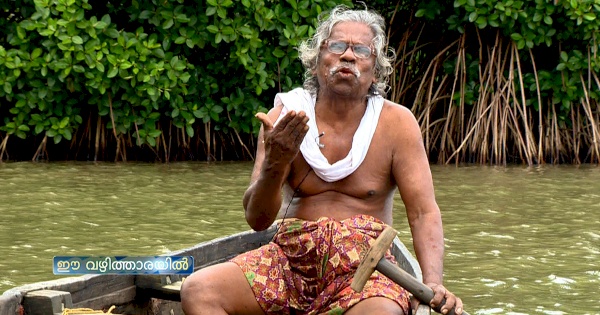
Pokkudan’s pursuit of mangrove conservation started back in the 80s when he started collecting mangrove seeds and planting them in the marshy lands of in Pazhayangadi. PHOTO: Mathrubhumi
Kallen Pokkudan, also known as Kandal (mangrove in vernacular) Pokkudan, an Indian environmental activist and writer from Kerala, devoted his life to mangrove forests and planted more than a hundred thousand mangroves over three decades across Kerala.These trees of the tropics offer a lifeline to areas under the threat of natural disasters, prevent soil erosion, form a breeding ground for marine animals, purify water, and sustain coastal livelihoods. Pokkudan’s pursuit of mangrove conservation started back in the 80s when he started collecting mangrove seeds and planting them in the marshy lands of in Pazhayangadi. His work to expand mangrove cover along the Indian coastline has earned him a UNESCO special mention.
As the noon breeze blows Pokkudan’s silver wisps into his eyes shaded by thick glasses, the octogenarian talks with an unvarnished matter-of-factness about the revolution he started in 1989. At a time when most people were ignorant of the many scientific and envi¬ronmental uses of mangroves, Pokkudan—until then a political thinker—saw them as wind-cheaters that, to a great extent, prevented schoolchildren from losing their umbrellas to strong winds blowing from the Ezhimala area. “I started planting mangrove saplings to shield school-going children from the wind,” says Pokkudan humbly. “I also believed they would prevent the sea from eroding the ground and, above all, I wanted to see the beautiful trees growing.”
Pokkudan began by planting 300 mangrove plants he had painstakingly collected from across Kerala’s marshy areas. Within a couple of years, they grew into thick green foliage span¬ning a kilometre. This was much before terms like ecosystem or ecotourism were flashed in newspapers and on hoardings in the state. At the time, many people criticised Pokkudan and even threatened him with legal consequences for ‘misusing’ panchayat land. Some others called him insane. Every morning he would be disheartened to see many of his saplings plucked and thrown into the river but his iron will kept him going. Deciding not to step back, he filed a police complaint and with his local political influence succeeded in starting a silent green movement.
It did not take long for his opponents to acknowledge his efforts and soon he came to be endearingly known as Kandal Pokkudan (Kandal means mangrove in Malayalam); a Botany professor from Kannur—Professor Lakshmanan—was the first to spot Pokkudan carrying a bag of seeds wherever he went. “In those days, I woke up every morning to only gather as many seeds I could and plant them,” beams Pokkudan.
No sooner had he got support from envi¬ronmentalists that a viral campaign went around the state for action against those who destroyed mangrove trees; in 1994, it reached the Kerala High Court. Pokkudan’s efforts started bearing fruit—when the then state government initiated the development of mangrove forests in Kannur district, it sought his help. By then, Pokkudan had planted over 100,000 saplings and turned his lonely battle into a social movement. Researchers from across the world were now making a beeline for this sleepy village. With his help, the Depart¬ment of Forests set up a mangrove nursery of around 30,000 seedlings. Several organisations began campaigning to convince people about the need to preserve mangrove forests, with Pokkudan travelling wherever he could.
Indeed, activism has come naturally to this man, who was born in 1930 in the Pulaya caste, one of the most discriminated in olden days. Owing to absolute poverty, Pokkudan could not complete his schooling and dropped out in Class 2. Nevertheless, imbued with a progressive outlook, he entered politics at a very early age. “There were only two personal experiences I had in mind—casteism and the difficulties our farmers faced.” Attracted to the communist ideology, which was very strong in Kannur, a teenaged Pokkudan became a member of the Karshaka Thozhilali Sangham (Agricultural Labourers’ Union of CPM). His fervour for every political and social activity, including the Peasant’s Revolt in the Malabar region, took him to prison many times.
However, his political association was strained when he raised his voice against caste dis¬crimination within the party. “Putting an end to my political activities, I was clueless and spent my days watching the monsoon lashing the marshy land,” Pokkudan recalls the birth of his mangrove mutiny. “For people of my com-munity, mangroves are a source of food, fuel and medicine. We used to cook mangrove seeds during famines. We were taught that these were nature’s ways to protect the land from natural disasters like winds, waves and soil erosion.” He also speaks with passion about the special types of fish that would come out of the salty seawater to lay eggs inside the thick mangrove bushes.
Today, the 300-odd seedlings Pokkudan planted have grown into a forest, making it a small ecosystem in itself with water birds, fish and turtles, including the rare Asian giant soft-shelled turtles protected under the Indian Wildlife (Protection) Act. What’s more, the forest has all the 22 mangrove varieties that can grow on a wetland. He proudly speaks about a newspaper report that quotes Hungar¬ian ornithologist Attila Bankovich, a visitor to Kannur last year, who spoke of the unmatched biodiversity in the district’s mangroves and appealed for their preservation.
Read more here.
 Organikos