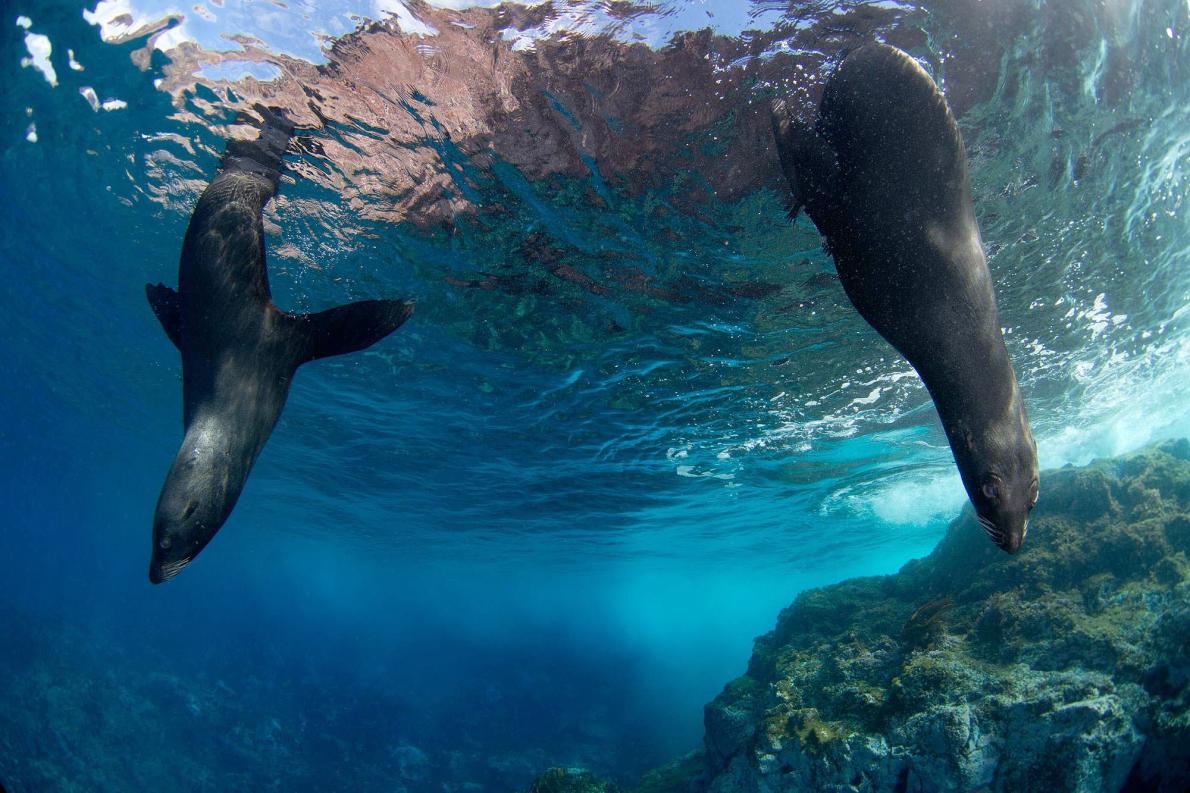
Two Juan Fernandez fur seals slide through the water off the Desventuradas Islands. Divers snapped them during a 2013 expedition to an area that is now the largest no-take marine reserve in the Americas. PHOTO: ENRIC SALA
Here’s another win for those who vouch for the ecosystem wealth that lie beneath the waters. The Chilean government on Monday announced that it has created the largest marine reserve in the Americas by protecting an area hundreds of miles off its coast roughly the size of Italy.
The new area, called the Nazca-Desventuradas Marine Park, constitutes about eight percent of the ocean areas worldwide that have been declared off-limits to fishing and governed by no-take protections, says Russell Moffitt, a conservation analyst with the Marine Conservation Institute in Seattle, Washington. (Read about the world’s largest marine reserve in the Pacific Ocean.)
The Pac-Man-shaped marine protected area (MPA) encompasses roughly 115,000 square miles (297,000 square kilometers) of ocean around San Ambrosio and San Felix islands. Together, they’re known as the Desventuradas (or Unfortunate in Spanish) Islands, which are part of the underwater Nazca Ridge, which runs southwest from Peru to Easter Island.
These islands had been subject to a modest amount of fishing, mainly for swordfish, before the creation of the new park, says Alan Friedlander, chief scientist for National Geographic Society’s Pristine Seas project. The project partnered with Oceana to promote designation of the new MPA. (Learn about what makes a successful MPA.)
Desventuradas sits in a unique oceanic environment, harboring a mix of tropical and temperate species. Due to its isolation from the mainland—it takes a two-day boat ride from Chile’s coast to get there—much of Desventuradas’ marine life is endemic, or found nowhere else in the world, says marine ecologist Enric Sala. Endemic species include Juan Fernández fur seals, the Chilean sandpaper fish, andJuan Fernández trevally.
About 72 percent of the species found around Desventuradas and an island chain known as the Juan Fernández archipelago—about 466 miles (750 kilometers) to the south—is endemic, says Sala, an Explorer-in-Residence with National Geographic who heads the Pristine Seas project, which aims to protect the last wild places in the oceans.
Monday’s announcement triples the amount of Chile’s offshore waters that are under the strongest protections.
“For many years, Chile has been one of the most important fishing countries in the world,” says Muñoz.
“Unfortunately, that led to depletion of our marine resources,” he says. “With the creation of this marine park around Desventuradas, we’re also becoming a leader in marine conservation.”
Read more here.
 Organikos
Pingback: A Tiny Land and Its Large Ocean Reserve | Raxa Collective