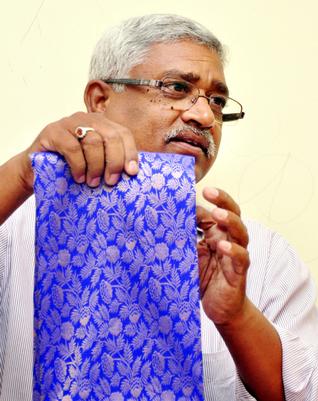
Kusuma Rajaiah displaying a sari made from ‘Ahimsa Silk’. Photo: Balachander Goud
Do you know how many silkworms are normally killed to make a five yard silk sari? Kusuma Rajaiah, a 55-year old government officer from India’s Andhra Pradesh state, does: “Around 50,000.” Rajaiah estimates that around 15 silkworms are normally sacrificed to produce a gram of silk yarn. For years, he’s been battling against what he describes as the “cruel killing of millions of innocent worms.” And has come up with an alternative. He realized the lure of silk was too strong to persuade people to give it up altogether so he came up with a technique that spares the life of the silkworm.
Ahimsa silk derives its idea and the brand name from Mahatma Gandhi, who was also critical of the conventional method of silk production. In fact, he had written to the Silk Board of India to explore ways of producing silk without hurting any living being. For Rajaiah, it’s a matter of pride to have fulfilled that wish; a pride shared by those who use the fabric.
In the production of regular silk, the cocoons are immersed in boiling water to kill the worms and spool the silk yarn. With Ahimsa silk, however, cocoons are left alone for seven to 10 days, until the caterpillars have metamorphosed into moths and flown away. Once the moth leaves the cocoon, the extraction of the silk filament begins.
“To weave a normal five-yard silk sari, one has to kill at least 50,000 silkworms,” explains Kranti Kiran Kusuma, Rajaiah’s son-in-law who manages the production of this unique fabric. “Those who know this think the killing is inevitable, while some don’t know this at all. We, however, check each cocoon individually to ensure that the moth has escaped before the silk thread is spun.” Now a small-scale, home-based business, it is supervised by Rajaiah’s parents, wife and two children, as Rajaiah himself is still an employed professional.
The whole process—from spinning to weaving—takes three months; it’s longer than the conventional way of making silk, as the cocoons are collected at least a week after the worms have left them. At present, Rajaiah can produce only up to 2,000 m of silk every month. Yet the inventor has no regrets. “Mass production is not my goal; I want the fabric to reach those who are able to understand and value the thought of non-violence attached to it,” he emphasises. “In fact, it is technically possible to develop this into a nationwide, even worldwide, venture with multiple franchisees.”
“The beginning was really tough; I had only an idea and my passion, but nothing else. There were no raw materials and no equipment,” remembers Rajaiah. “I knew I had to begin from scratch and follow a long-drawn process. From finding a farmer willing to grow silkworms to looking for a factory where I could spin yarn, I had to struggle before my experiment bore fruit. Finally, in 1991, the Lohia Group of Industries in Raipur, Chhattisgarh, allowed me to use their facility. It was there that I took 100 kg of silk cocoons. Each of these cocoons was empty inside as the silk moth had bored a hole on the surface and flown away. Using the spinning equipment at the factory, I started to extract the yarn from these cocoons. Finally, I was able to spin 16 m of silk yarn.”
Read more here.
 Organikos