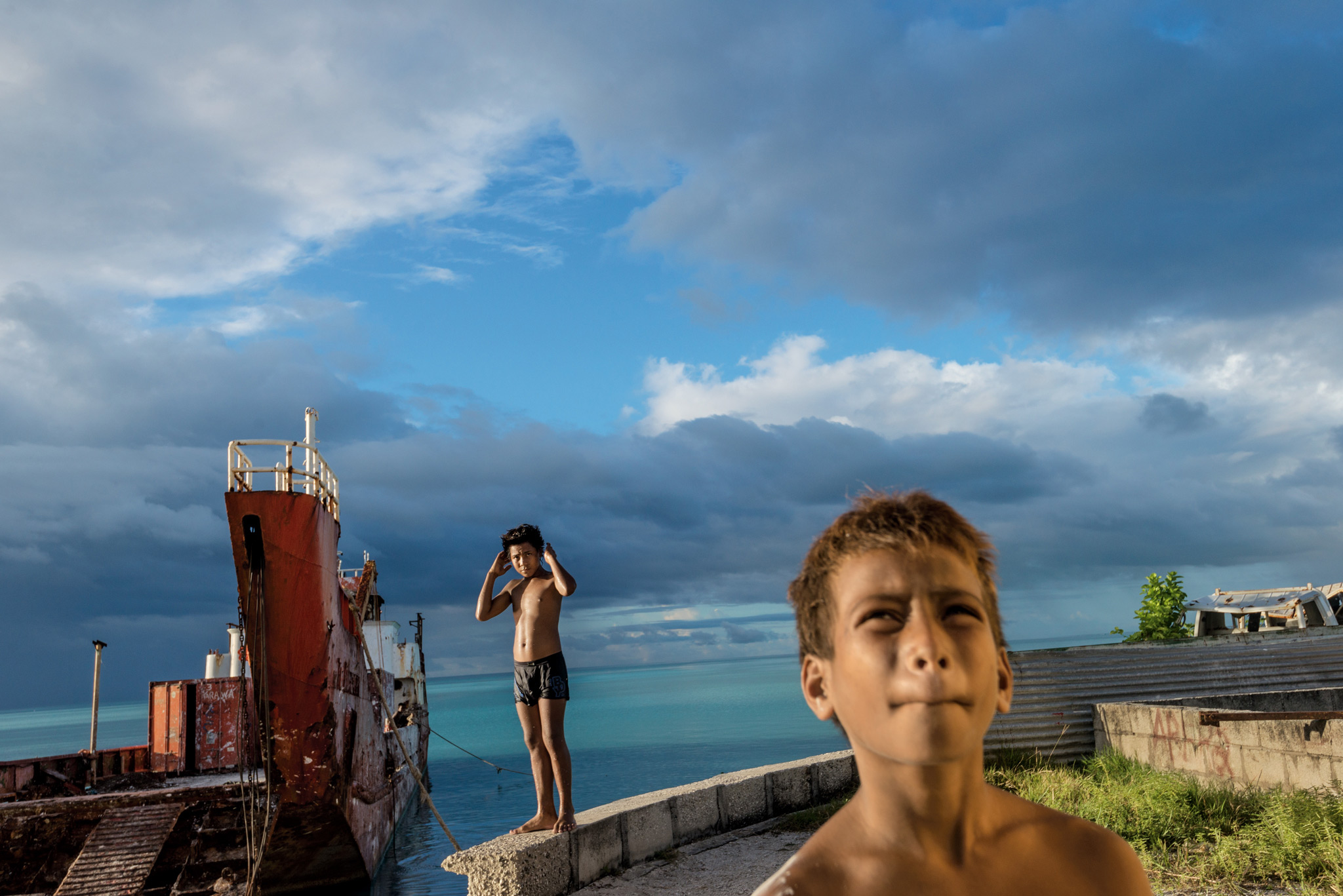
Kiribati—33 coral islands in an expanse of the central Pacific larger than India—is “among the most vulnerable of the vulnerable” to climate change. PHOTO: Kadir Van Lohuizen
They do not think of themselves as “sinking islanders,” rather as descendants of voyagers, inheritors of a proud tradition of endurance and survival.
That’s how National Geographic captures the spirit of the people of Kiribati, a spirit that forgives the seas despite the threats that its warming, rising, acidifying waters pose to their native islands. A people who believe that planting mangroves will stop the encroaching sea in its tracks, a people whose lives are centered on the seas that without it, they maybe forced to question who they are. This is their story then, from “the front line of the climate-change crisis.”
Many I-Kiribati refuse to think of their homeland as a “disappearing island nation,” its fate already out of their hands. They do not think of themselves as “sinking islanders,” rather as descendants of voyagers, inheritors of a proud tradition of endurance and survival.
They believe their paradise is far from lost.
But it is surely suffering. The sea is becoming an unwelcome intruder, eroding the shoreline and infiltrating soils, turning wells brackish and killing crops and trees. Atolls like Tarawa rely for their fertility on a lens of freshwater, replenished by rain, which floats on a saltwater aquifer. As the sea level rises—a few millimeters a year at the moment but likely to accelerate—so does the level of salt water underground, shrinking the freshwater sweet spot.
“Now we hate the sea,” Henry Kaake told me as we sat in his kiakia, an open-sided hut on stilts used for both sleeping and chatting with friends. “Yes, the sea is good for us to get our food, but it is going to steal our land one day.”
Even so, some I-Kiribati reject the rhetoric of victimhood and the implication that Pacific nations are powerless. “We are not victims,” Toka Rakobu, who works for a Tarawa tourism agency, told me. “We can do something. We are not going to be a defeated people.”
Read more of how Kiribati is trying to make sense of climate change.
 Organikos
Pingback: When a Way of Life Melts With the Ice | Raxa Collective