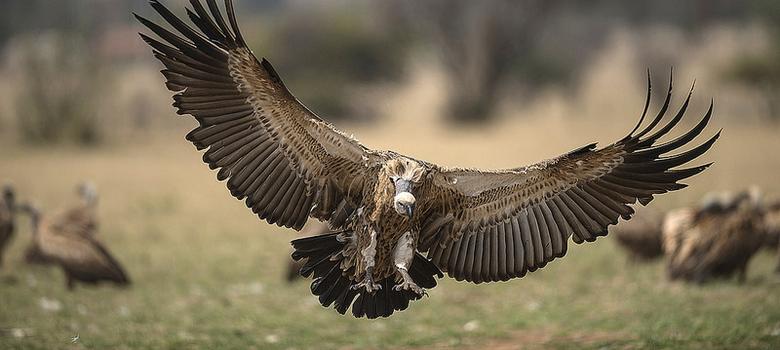
69% of vulture and condor species are listed as threatened or near-threatened, most of which are classed as “endangered” or “critically endangered”. PHOTO: Mujahid Safodien
Vultures play an important role in the ecosystem by consuming animal carcasses, which helps prevent the spread of disease. The cinereous vulture (Aegypius monachus), the largest bird of prey is distributed throughout Eurasia and is an iconic bird in the Far East. Its population is estimated to number 7,200–10,000 pairs globally, with 5,500–8,000 pairs residing in Asia. Over the past two centuries, its numbers have declined across most of its range leading to this species being classified as ‘near threatened’ on the International Union for Conservation of Nature (IUCN) Red List.
69% of vulture and condor species are listed as threatened or near-threatened, most of which are classed as “endangered” or “critically endangered”. The California condor (Gymnogyps californianus), for instance, was declared extinct in the wild in 1987 when the last remaining individuals were removed and placed in captivity to protect them from lead poisoning from ingesting shot and bullet fragments from hunted carcasses. Although captive-breeding and release programs have allowed the wild population to increase to more than 200 individuals, lead poisoning continues to cause fatalities.
Across Asia the big problem is accidental poisoning by diclofenac, an anti-inflammatory used to treat cattle. In vultures and some eagle species, tiny traces of the drug can lead to fatal kidney failure within 48 hours. In just 15 years, cow carcasses contaminated with diclofenac nearly wiped out three of Asia’s vulture species.
This had a big knock-on effect. With less competition at carcass disposal dumps, where people once let vultures pick dead animals clean, India’s feral dog population exploded. This caused higher rates of rabies transmission at an estimated additional cost of US$34 billion to the country’s healthcare between 1993 and 2006.
Although some populations have started to recover following the ban of diclofenac in India in 2006, a logic-defying 2013 approval to licence the drug for use in Europe now threatens vultures there too, particularly in Spain and Italy. In Spain, replacing the natural carcass disposal service provided by vultures with vehicle transport to processing plants would result in the equivalent of an additional 77,344 metric tons of CO2 being emitted to the atmosphere and US$50m of additional payments to insurance companies each year, according to a 2014 study in Nature.
Read more on how ivory poachers are poisoning vultures in Africa.
 Organikos