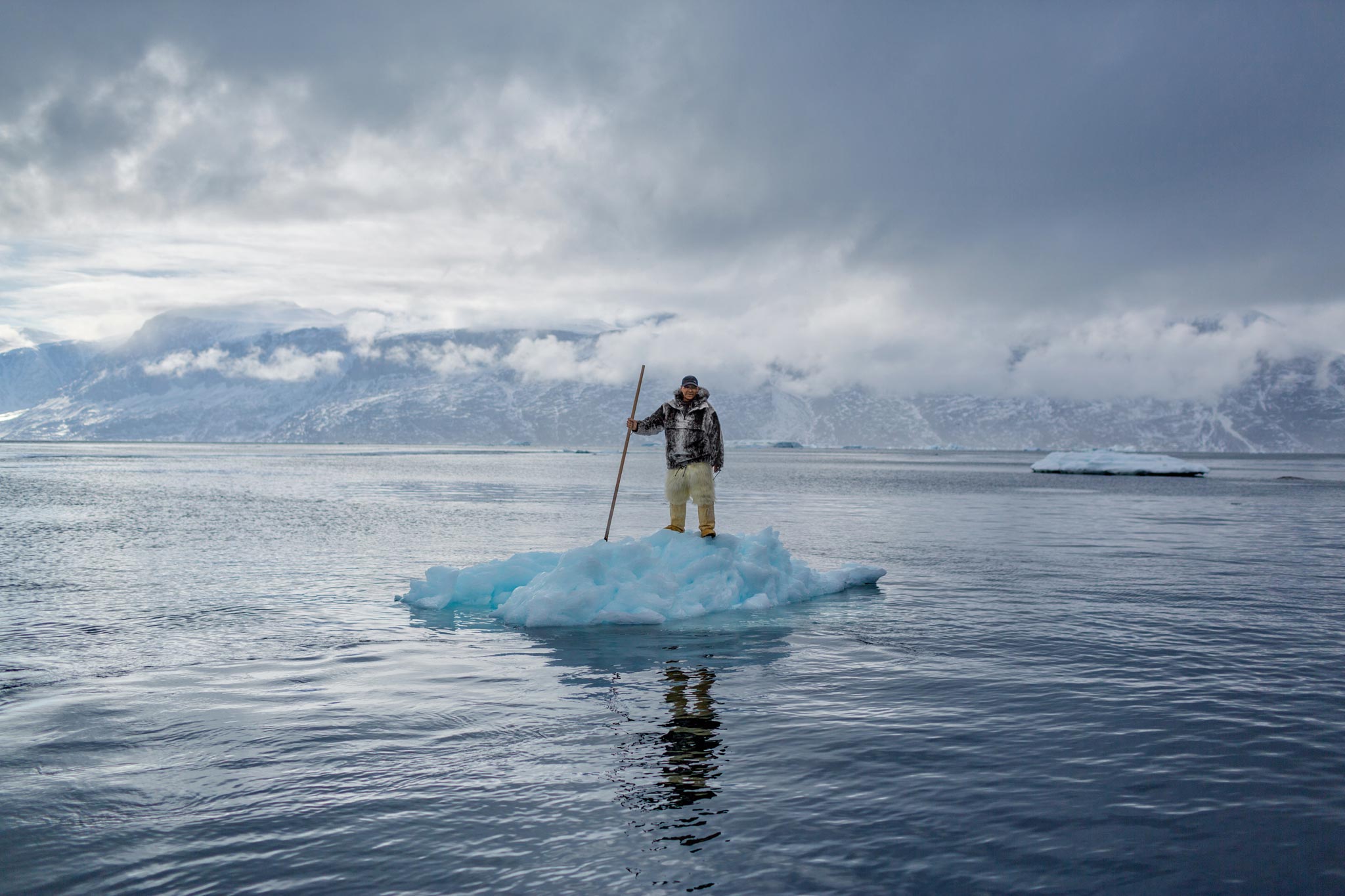
Albert Lukassen’s world is melting around him. When the 64-year-old Inuit man was young, he could hunt by dogsled on the frozen Uummannaq Fjord, on Greenland’s west coast, until June. This photo shows him there in April. PHOTO: Ciril Jazbec
Climate change – a situation that choices can better, but circumstances see it go from bad to worse. Much talk, much less done. Temperatures rise, glaciers melt, and seas begin to usurp shores. Also, people like the natives of Kiribati and now the Inuit are forced to rethink ways to survive on their lands which once provided for all. And did not threaten their lives. National Geographic reports from the North:
Something else is vanishing here too: a way of life. Young people are fleeing small hunting villages like Niaqornat. Some of the villages struggle to support themselves. And now a culture that has evolved here over many centuries, adapting to the seasonal advance and retreat of sea ice, is facing the prospect that the ice will retreat for good. Can such a culture survive? What will be lost if it can’t?
WHEN THE SEA FREEZES, the world of the north suddenly becomes larger. Horizons expand even as daylight contracts. Greenlanders, all 56,000 of them, live their lives facing seaward, with a vast, uninhabitable interior at their backs. No roads cross the glaciers and plunging fjords that separate the scattered coastal towns. These days planes, helicopters, and fast motorboats help connect them—but traditionally, at least in more northerly places like Uummannaq, it was sea ice that brought an end to isolation and autumnal little-town blues. In winter dogsleds, snowmobiles, even taxis and fuel trucks can maneuver across what had been open water. For as long as the Inuit have been in Greenland, winter has been the time for visits, journeys, and hunts.
CLIMATE CHANGE IS MAKING the economies of the settlements even more precarious. It has lengthened the periods in winter and spring when ice is too thick for boats to leave harbors yet not thick enough to support sleds or snowmobiles. The unsafe ice affects fishing, but it hurts the region’s hunters more.
“In the 1980s we had cold winters,” says Uunartoq Løvstrøm, a lean 72-year-old hunter and one of 200 residents of Saattut, a small island near the head of Uummannaq Fjord. “And ice was this thick,” he says, rising from a sofa and placing his hand even with his hip.
At the height of winter in recent years, says Løvstrøm, ice in the fjord might be only a foot thick. Instead of icing over in December or January and melting in June, the sea freezes in February and starts to thaw in April. The loss of ice has shortened the hunting season, in a land where wild meat helps families get by: Seal, reindeer, and whale meat fills freezers for the year. And shooting seals from boats is a poor substitute for the traditional dogsled hunt. A hunter on a sled can get off and stealthily approach his prey. On a noisy boat, he can’t get as close; from a distance he must take a difficult shot at a seal coming up for air in open water.
When a hunter does bag a seal, it sinks through a surface layer of fresh glacial meltwater and floats on top of the salt water below. The hunter has to haul it up. But the glaciers flowing into Uummannaq Fjord are melting faster than ever. The freshwater layer is getting thicker, so the dead seals sink deeper. Sometimes now they’re out of reach.
Read more here.
 Organikos