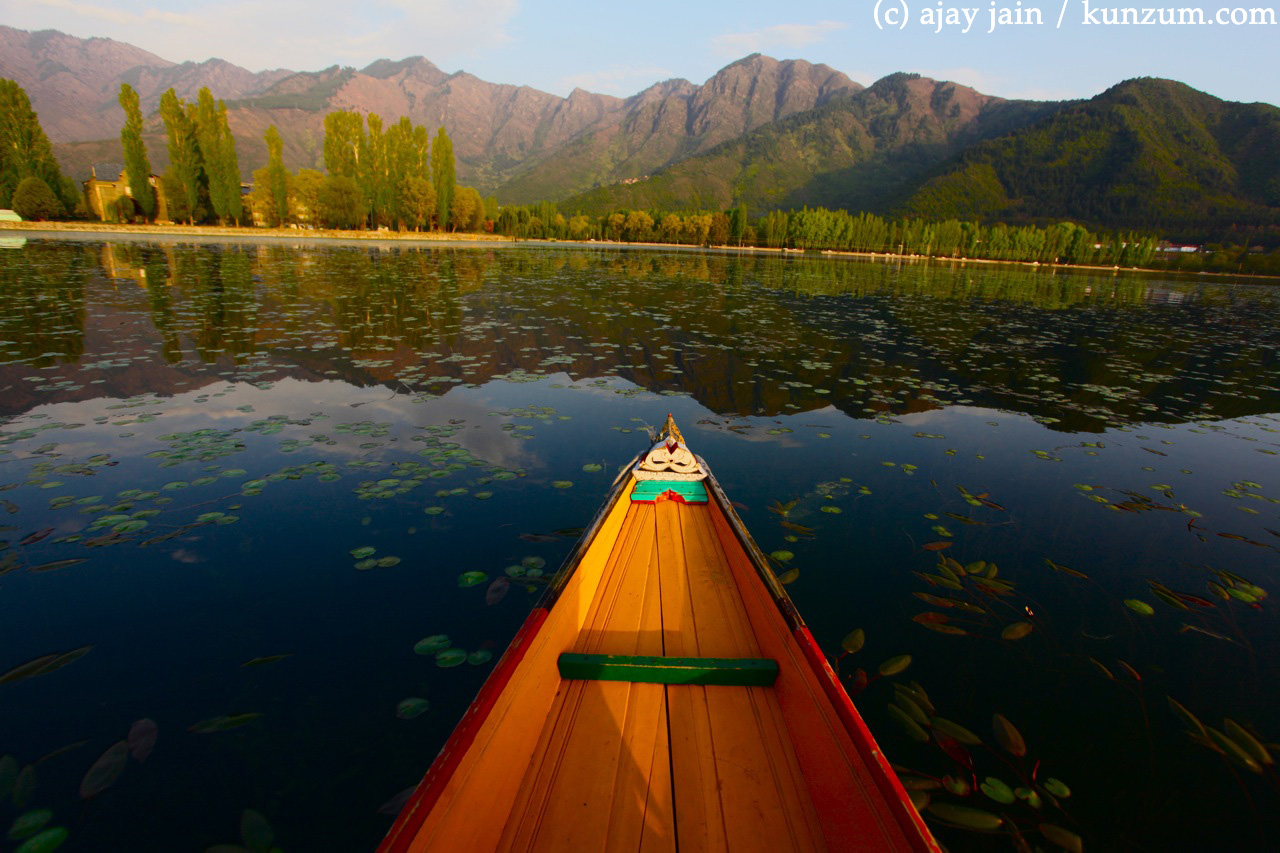
Half of the water bodies in and around Srinagar have disappeared over the last century under the pressure of rapid and badly managed urbanisation. PHOTO: Kunzum
Urban India is witnessing a rapid growth with more than 300 million Indians already living in cities and towns. In the coming 20-25 years, another 300 million people will be added to the urban population. If not managed properly, Indian cities will turn into ecological disaster zones. In a hurry to expand, cities have already eaten into their local water bodies. Kashmir, the land of snow\clad mountains and unrivaled natural beauty, is feeling the heat already.
The beautiful Kashmir Valley has over a thousand small and large water bodies, which are the bedrock of both its ecology and its economy. Unfortunately over the last century, massive urbanisation around these water bodies has led to pollution, siltation due to deforestation and overexploitation of the many streams and lakes. Many have shrunk to a fraction of their original size while some have all but disappeared.
According to the State Water Mission, water bodies in Kashmir are the worst victims of human interference and rapid urbanisation. Massive erosion in the catchment area is resulting in these lakes becoming silted up, thereby converting water areas into landmasses. Other water bodies have disappeared due to natural causes like glacial action and low precipitation. Some are on the verge of extinction.
More than 50% of water bodies in Srinagar and its suburbs have been lost during the past century, Humayun Rashid and Gowher Naseem of Srinagar’s Directorate of Environment, Ecology and Remote Sensing have concluded in a study.
Towns like Pahalgam, Sonamarg, Srinagar and Sopore – must-see places on the tourist map of the valley – owe their existence to water bodies. These include the Lidder River, the Hokarsar wetland, Dal Lake, Wullar Lake and the Manasbal Lake. According to tourism department officials, over 10 lakh tourists visit these places annually and around three lakh people are directly and indirectly dependent on these tourist places for their livelihood.
The multimillion dollar handicrafts industry of Kashmir, which gives employment to over two lakh people, is also heavily dependent upon the arrival of tourists in the region. A study on the Impact of Tourism Industry on Economic Development of Jammu and Kashmir says that almost 50-60% of the total population of Jammu and Kashmir is directly or indirectly engaged in tourism-related activities. The industry contributes 15% to the state’s GDP.
Another big contribution of Kashmir’s water bodies to the state’s economy is the revenue generated through taxation of water usage for electricity generation by power development agencies like the National Hydroelectric Power Corporation. According to Jammu and Kashmir’s Economic Survey of 2014, revenue of Rs 24.2 crore has been realised since 2010 on account of water usage charges on hydroelectric projects in the state.
It is estimated that over 1.5 lakh Kashmiris get direct and indirect employment from sand extraction and fishing. Figures available with the geology and mining department suggest that sand worth 15 crore is extracted each year from Kashmir’s water bodies, particularly from the Jhelum and its tributaries, through the organised sector. This does not take into account the fact that 40% of sand extraction – worth Rs 7.5 crore – is carried out illegally, an official said on condition of anonymity.
Fisheries is another big livelihood generation sector linked to the water bodies. Masood Hussain Balkhi of Sher-e-Kashmir University of Agricultural Sciences and Technology said that aquatic resources of Jammu and Kashmir form about 16% of the total area of inland aquatic resources of India. Fisheries are an Rs 5.5 crore industry in Kashmir and employ over 90,000 people both directly and indirectly.
His colleague, Farooz Ahmad Bhat, added that annual fish production of the region is 20,000 tonnes. Fish diversity and production in Kashmir have shown a sharp decline over the past few decades and some local fish species had even become endangered and threatened. The ramagurun (Botia birdi), for instance, which was once abundant, has now almost disappeared as has the algaad (Schzothorax niger), Bhat said, blaming encroachment, pollution and siltation.
Read more here.
 Organikos