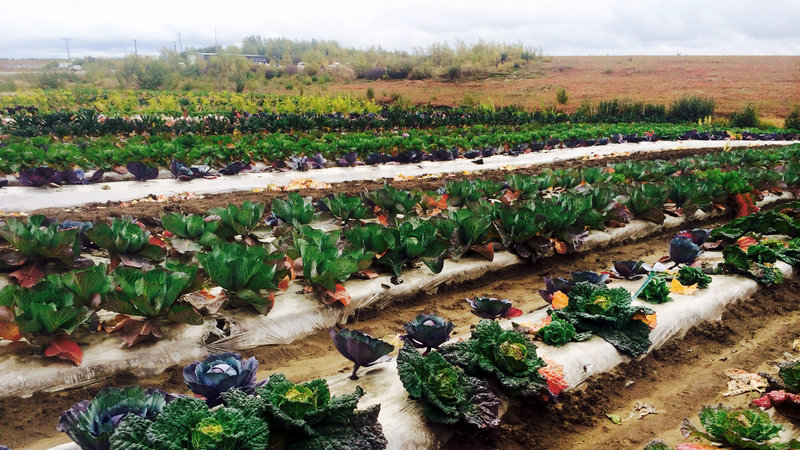
A field near harvest time at Meyers Farm in Bethel, Alaska, can now grow crops like cabbage outside in the ground, due to rising temperatures. PHOTO: Daysha Eaton/KYUK
Farming in the Arctic? Well, it can be done. The reasons are many. For one, the climate is changing: Arctic temperatures over the past 100 years have increased at almost twice the global average.
On a misty fjord in Greenland, just miles from the planet’s second largest body of ice, Sten Pedersen is growing strawberries. Yellowknife, a Canadian city 320 miles below the Arctic Circle, hosted a farmers market this summer. And a greenhouse in Iqaluit, the capital of the vast Canadian Inuit territory of Nunavut, is producing spinach, kale, peppers and tomatoes. The frozen tundra of the Arctic is experiencing something of an agriculture boom. More
According to NPR, 2014 ranked as the warmest year on record in Alaska.
But some Alaskans, like farmer Tim Meyers, are seeing warming temperatures as an opportunity.
Now that potato harvest is underway at his Bethel farm, Meyers uses a giant potato washer, like a washing machine for root vegetables, to clean California white potatoes.
They’re some of the only commercially produced vegetables in this southwestern Alaska region, about the size of Oregon.
Meyers says the warming summers are a big part of his success.
“I hate to say that but I guess I’m taking advantage of the fact that it is getting warmer,” he says.
He says working the tundra — plowing swampy bogs full of silty soil — is tough. But he’s adapted to farming in the subarctic, even making his own homemade, fermented fish fertilizer.
At the 15-acre organic farm, which has been operating for more than a decade, Meyers is growing crops like strawberries in greenhouses. But he says as temperatures warm due to climate change, it’s easier to grow things like potatoes, cabbages and kale right in the ground, outside.
“Years ago, it was hard freeze and below zero up to the third week in May,” he says. “We haven’t had any of that this winter.”
Read more here.
 Organikos