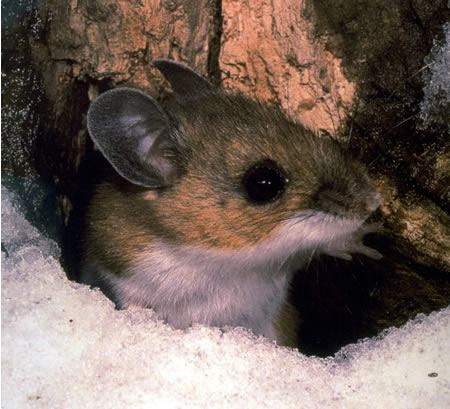
Deer mouse photo by National Park Service, via Wikimedia Commons
We should all be concerned with animal diseases, especially if those pathogens have the potential to become zoonotic, or transmittable to human beings. And if you agree that biodiversity is one of Earth’s great treasures and essential to the health of its ecosystems, then it won’t come as a surprise to hear that there seems to be a link between a habitat’s biodiversity and fewer zoonotic diseases in the respective area.
This situation is known as the dilution effect in epidemiology, and Jason Goldman reports for University of Washington’s Conservation Magazine on the case of a certain hantavirus (which is a zoonotic virus carried by rodents) studied within deer mice in Utah:
Deer mice are the natural hosts for the Sin Nombre hantavirus, or SNV. When contracted by humans, the virus can lead to the sometimes fatal Hantavirus Pulmonary Syndrome.
To test the dilution effect in a deer mouse population, the researchers trapped 155 of the rodents on BLM land in Juab County, Utah, and implanted small microchips inside them. They also took a small blood sample to test for SNV infection. Then they distributed an array of feeding trays in the desert, half in areas of high biodiversity and half in areas of low biodiversity.
Half of the trays were placed in “protected” spots, offering a bit of protective cover to the hungry mice, while half were left exposed. “Bolder” mice were expected to feed more often at exposed stations, while “shy” ones would prefer to forage at the protected feeders. Each feeding station was equipped with a microchip scanner, to identify the mice when they came to eat, and a camera.
Over the course of nearly seven weeks of data collection, Dizney and Dearing collected more than 3,000 hours of information from the chip scanners and around 1,000 hours of video footage. The videos not only allowed them to look for interactions among deer mice, but also to see what other species were visiting the feeding stations: pinyon mice, western harvest mice, Great Basin pocket mice, Ord’s kangaroo rats, and others.
SNV was four times more prevalent at the collection sites with less biodiversity than those with more biodiversity. That’s despite similar density and demographics of the deer mouse populations.
Read the rest of the original Conservation Magazine article here.
 Organikos