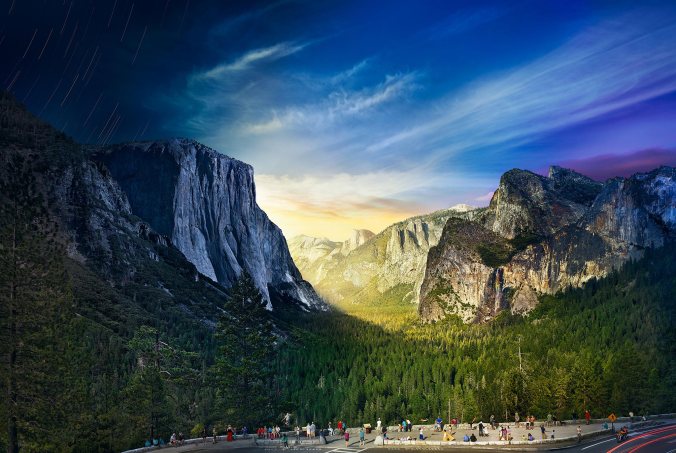
Photographs of Yosemite National Parks composed by Stephen Wilkes. Courtesy: National Geographic
Which side are you on – the one that believes national parks are the past or to the side that sees the future in these stretches? As long as national parks figure on your maps and feature in your scheme of things, you must know that the National Park Service is celebrating its centennial this year. In commemoration, National Geographic looks at how to preserve these wild spaces:
“In March 1868 a 29-year-old John Muir stopped a passerby in San Francisco to ask for directions out of town. “Where do you wish to go?” the startled man inquired. “Anywhere that is wild,” said Muir. His journey took him to the Yosemite Valley in California’s Sierra Nevada, which became the spiritual home of Muir’s conservation movement and, under his guidance, the country’s third national park. “John the Baptist,” he wrote, “was not more eager to get all his fellow sinners into the Jordan than I to baptize all of mine in the beauty of God’s mountains.” Today around four million people a year follow their own thirst for the wild to Yosemite.”
The early parks in the American West had been established primarily to protect scenic wonders, splendors of soaring rock and tumbling water and perennial ice, severe places that offered little prospect for economic exploitation—except maybe in the form of tourism as envisaged by railroad tycoons. That perceived dearth of business opportunity, plus the patriotic savor of touting America’s natural “cathedrals” in counterpoint to the cathedrals and monuments of old Europe, made creating parks easier than it would be later. Another factor was the negative example of Niagara Falls, where the best overlooks had been bought up and fenced by private operators, turning a national icon into a cheesy, for-profit peep show. Heaven forbid that should happen to Old Faithful or the Yosemite Valley. Protection of living creatures—the American bison in Yellowstone, the gigantic Sierra redwoods later known as sequoias—became part of the idea too. But it wasn’t until 1947 that any U.S. national park was approved largely for the protection of wildlife. That was Everglades National Park, a vast wetland in Florida, lacking mountains or canyons but full of birds and alligators.
Since then, our national parks have gradually taken on the high purpose of preserving nature’s diversity—native fauna and flora, ecological processes, free-flowing waters, geology in its raw eloquence— as exemplars of Earth’s interactive complexity, not just as scenic wonderlands. Now they teach us as well as delight us. They inspire active curiosity as well as passive awe. They help us imagine what the American landscape and its resident creatures looked like before railroads and automobiles and motels existed. Repeat: They help us imagine. They carry a glimpse of the past into the present and—if our resolve holds and our better wisdom prevails—they will carry that into the future.
Read more here.
 Organikos
I visited several times some of the National parks in the USA… quite few of them actually. Each time was a great experience, that great in fact that I still remember vivid as it was Yesterday… Parks are a little wonder for the future generations as well, and I wish it will remain protected in the years to come.
Have a lovely week :-)claudine
Thanks Claudine – the National Parks are one of the USA’s greatest attributes. We’re so glad you were able to visit many of them and hope you will be able to enjoy the others in the future.