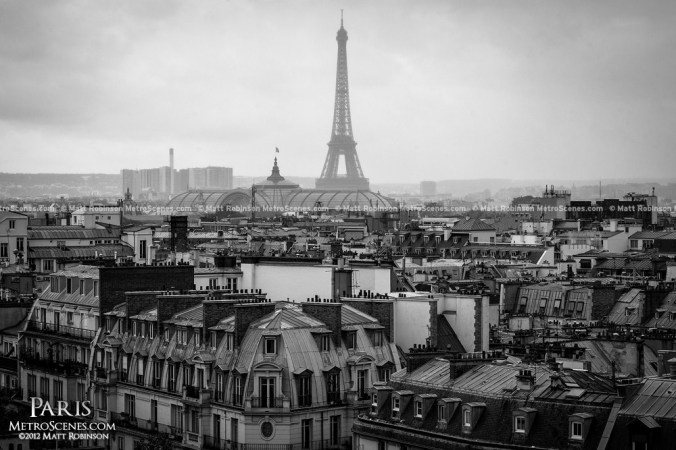
In the 19th century, George-Eugene Haussmann completely redesigned and rebuilt the French capital. PHOTO: Matt Robinson
“Paris was a universe whole and entire unto herself, hollowed and fashioned by history; so she seemed in this age of Napoleon III with her towering buildings, her massive cathedrals, her grand boulevards and ancient winding medieval streets–as vast and indestructible as nature itself. All was embraced by her, by her volatile and enchanted populace thronging the galleries, the theaters, the cafes, giving birth over and over to genius and sanctity, philosophy and war, frivolity and the finest art; so it seemed that if all the world outside her were to sink into darkness, what was fine, what was beautiful, what was essential might there still come to its finest flower. Even the majestic trees that graced and sheltered her streets were attuned to her–and the waters of the Seine, contained and beautiful as they wound through her heart; so that the earth on that spot, so shaped by blood and consciousness, had ceased to be the earth and had become Paris.”
― Anne Rice, Interview with the Vampire
Literature, history, art, everyday news, talk at a neighborhood cafe – the exquisite and the commonplace are rife with paeans to this city. But how did she come into being?
The BBC notes:
Paris remains one of the world’s most visited cities, and of those tens of millions drawn to its remarkably compact centre each year, the Marais district exerts a magnetic pull. Fashionable among aristocrats before Louis XIV – the “Sun King” – moved his court from Versailles, this pungent quarter of narrow streets and jumble of historic houses and courtyards sank into near-squalor in succeeding centuries before its renaissance in recent decades as a charming labyrinth of fashion boutiques, cafés, restaurants, museums and galleries.
Walking through these lively and endearing medieval streets, it seems almost incredible that they were once considered the enemy, to be demolished in haste – and not, it has to be added, by the German military, who had less than healthy designs on Paris at various times between 1870 and 1945. No, it was none other than the Emperor of France, Napoleon III, and his Prefect for the Seine, George-Eugène Haussmann –who died 125 years ago – who had districts like the Marais in their sights.
Like much of Paris, however, the Marais stank to high heaven in 1853 when the emperor instructed Haussmann to rebuild the odorous city along grand and salubrious lines. Entire medieval quarters of the city were to be razed with modern avenues taking their place. “It was the gutting of Paris,” wrote Haussmann proudly in his Memoirs.
A public administrator with no training in architecture or urban planning, Haussmann turned Paris into a titanic building site for 20 years. Even though he was forced to resign in 1870 as the emperor faced growing criticism for excessive expenditure, work on Haussmann’s plan continued until the late 1920s.
More here.
 Organikos