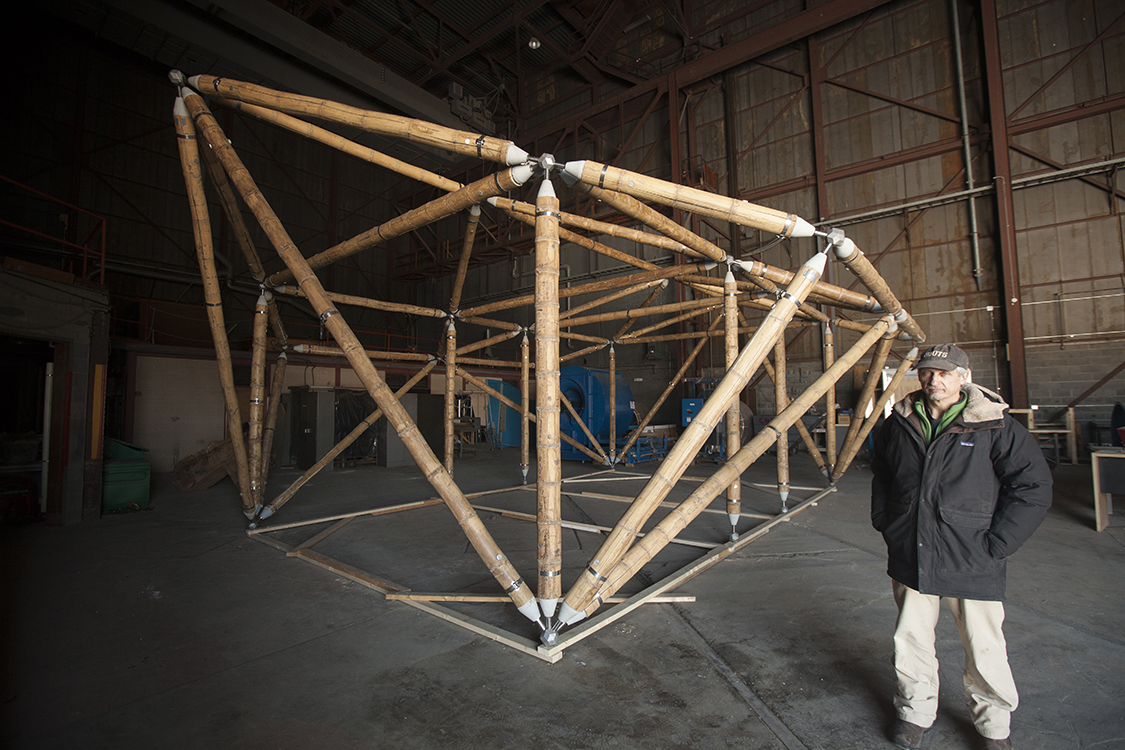
Jack Elliot and students completed a test build in Cornell’s High Voltage Laboratory before erecting the structure in the Dominican Republic. Photo © Robert Barker / University Photography
Bamboo comes up frequently on this blog, since it is such a fast-growing plant that can be used in various ways for construction and design. Recently, we learned of a collaborative project at Cornell University where bamboo-based structures intended to resist the violence of earthquakes and hurricanes in the Caribbean (and tested on the island of the Dominican Republic) use an aluminum joint system invented by a Cornell professor. Roger Segelken reports for the Cornell Chronicle:
The first field test of Design and Environmental Analysis (DEA) associate professor Jack Elliott’s “Triakonta” structural system stands in the Punta Cana coastal region of the Dominican Republic, as an outdoor classroom for the Puntacana Ecological Foundation.
“The structure itself is elegant and has sparked dialogue about sustainable architecture amongst visiting guests, students and even architects,” said Jake Kheel, M.S. ’02, environmental director of Grupo Puntacana, which operates a resort adjoining the eco-preserve where Cornellians and locals built the bamboo structure in mid-2015.
Named for the triacontahedron – a 30-sided rhombic polyhedron first depicted in the 1600s by mathematician Johannes Kepler – Triakonta metal nodes (fasteners) hold together struts (framing timbers) in nearly any orientation a designer can imagine. Combining cast-aluminum Triakonta nodes with bamboo struts of three different lengths, Elliott’s structure can be assembled anywhere, in all shapes and sizes, and disassembled later for subsequent reuse.
Elliott, a College of Human Ecology faculty member since 1998, invented the Triakonta system after he was asked to design a multipurpose building for the Ithaca Children’s Garden. Elliott’s initial designs weren’t “figurative enough” for administrators at the garden, which features a giant, earthen playscape in the shape of a turtle.
Read the full original article here.
 Organikos