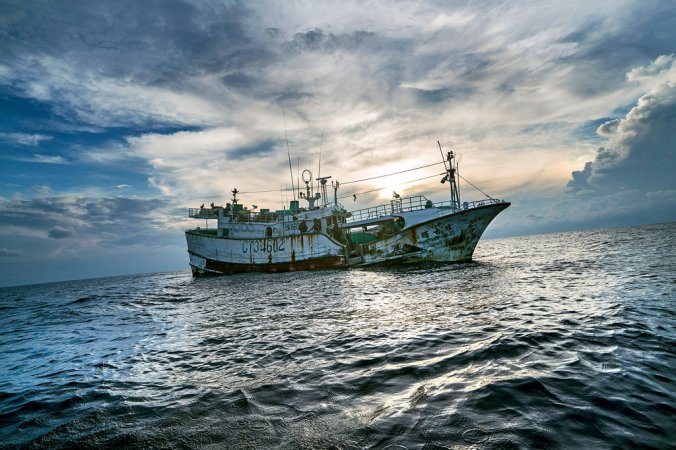
The Sheng Chi Huei 12, a Taiwanese fishing vessel. BENJAMIN LOWY/REPORTAGE, FOR THE NEW YORK TIMES
Where are the heroes on the high waters? Sea Shepherd, one of our favorites, is out there and Paul Watson continues to lead the charge; but not only them. Little places also do big things. Thanks to Palau for the inspiration, and the reporter/publication for the investigation:
Palau vs. the Poachers
The island nation has mounted an aggressive response to illegal fishing in their waters. How they protect themselves may help the rest of the world save all of the oceans.
Late on a January 2015 evening in Shepherdstown, W.Va., a data analyst named Bjorn Bergman, surrounded by whiteboards scribbled with computer code, was orchestrating a high-stakes marine police chase halfway around the world. Staring at his laptop in a cramped ground-floor office, he drank from his sixth cup of coffee and typed another in a long series of emails: ‘‘Try and cut them off rather than making for the last known position.’’ Nearly 9,000 miles away, the Remeliik, a police patrol ship from the tiny island nation Palau, was pursuing a 10-man Taiwanese pirate ship, the Shin Jyi Chyuu 33, through Palauan waters. Bergman, working for a nonprofit research organization called SkyTruth, had mastered the use of satellite data to chart a ship’s most likely course. Instead of pointing the police to where the pirate ship was, he would tell them where it was about to be. He took another sip of coffee, studied his screen, then typed again: ‘‘It may be advisable for the Remeliik to turn southeast.’’Caught fishing in a marine sanctuary, the Shin Jyi Chyuu 33 was fleeing to Indonesian waters, beyond Palau’s jurisdiction. Once across the boundary, the crew could easily unload its catch at a local wharf and disappear among the thousands of small Filipino or Indonesian islands of the western Pacific. Determined not to let that happen, the Remeliik’s skipper, running on Bergman’s coordinates, was pushing 15 knots — a pace that worried its engineer. But the police were desperate to keep up. In the previous six months, they had spotted but failed to capture nearly a dozen other pirate fishing ships. If the Remeliik’s officers miscalculated their heading by even a small fraction of a degree, they would miss their target.
Bergman had been tracking the Shin Jyi Chyuu 33 for weeks, and emailed an alert about possible illegal fishing two days earlier. Before moving to West Virginia to work for SkyTruth, he spent three years working as a marine observer on Alaskan fishing boats, logging the details of the daily catch, as required by federal and state fishery authorities. At SkyTruth, Bergman did his surveillance work from a far greater remove, monitoring ships by satellite. For months, he had been studying a satellite feed from above Palau. He knew its squiggles and slashes by memory. A passenger boat out of Pitcairn Island appeared every few weeks; a United States Navy ship from Diego Garcia conducted regular maneuvers; a Chinese research vessel was doing a survey of some sort in a grid pattern; a Taiwanese ship that never seemed to fish made repeated trips out to meet other long-line fishing vessels. The Shin Jyi Chyuu 33 stood out, however. Switching among registries of fishing permits, regional tuna licenses and blacklisted vessels, he could tell it had no license to fish in Palau’s waters, even though its zigzag trajectory indicated it was doing just that…
Read the whole article here.
 Organikos