Serpentine pavilion ‘unzipped’: first look at Bjarke Ingels’ design
The Danish architect offers a sculptural space ‘like a mountain of ice cubes’ stretching across the London gallery’s lawn, to be complemented by four radical summer houses
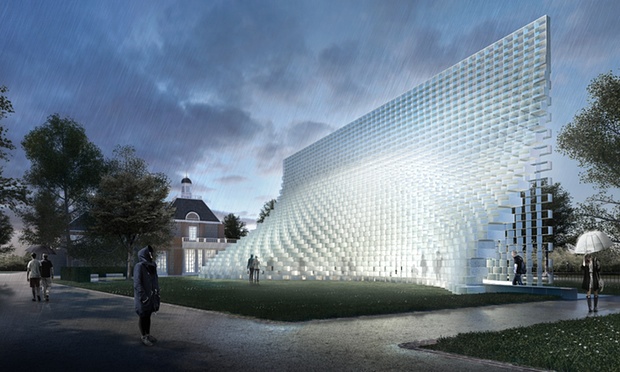
‘Cartoonish gyrations’ … Bjarke Ingels Group (BIG) architectural impressions of the 2016 Serpentine pavilion.
The humble brick wall, that most London of architectural elements, is the inspiration for this year’s Serpentine Gallery pavilion, according to designs unveiled today. But in the hands of the Danish architectural conjuror Bjarke Ingels and his firm BIG, it won’t be any old brick wall. It’s a wall that will be stretched open and hollowed out, its oversized fibreglass bricks stacked up to form a paraboloid enclosure that will taper high above the park, transforming from a bulging cave to a slender screen as it undulates across the lawn.
As usual for an architect who describes his voracious approach as “bigamy”, the structure is trying to be everything at once, containing allusions to some of the 15 pavilions that have gone before and mashing them up into a heady cocktail. It will be “free-form yet rigorous”, says Ingels, “modular yet sculptural, both transparent and opaque, both solid box and blob”. It sounds like every architectural tic at once, every design meme sublimated into an amorphous heap.

Inside BIG’s Serpentine pavilion, the undulating space is intended to feel like a ‘glacial cave’.
But a beguiling heap it may well turn out to be. From some angles, the stack of fibreglass brick frames promises to dissolve into a transparent grid, from others it will appear like a mountain of ice cubes. Pulled open, or “unzipped” as Ingels has it, the inhabitable wall will house spaces for events inside, with the translucent fibreglass structure giving it the feeling of stepping into a glacial cave.
In its cartoonish gyrations and pixelated form, the pavilion alludes to various other BIG projects currently under construction around the world. The practice is working on a new home for Lego in Billund, in the form of a stack of oversized bricks, while, in one particular view, the pavilion looks disarmingly like a scale model of their West 57th Street project, a pyramidal skyscraper in New York – which might be no coincidence, given the scheme of luxury apartments launches soon. What better billboard than a pavilion in Kensington Gardens?
This year, for the first time, the main pavilion commission will be joined by four smaller summer houses by a range of other architects, who have each been asked to respond to Queen Caroline’s Temple, a classical stone summer house that sits a little to the north, built by William Kent in 1734…
 Organikos