
“Sandcastle No. 3,” drawn on a single grain of sand, part of a Vik Muniz series from 2013.CreditVik Muniz, via Sikkema, Jenkins & Co.
We like it, for what should be obvious reasons:
At M.I.T., Science Embraces a New Chaos Theory: Art
“If you ever try to do something in a science lab that’s not science, people look at you in a really funny way,” said Mr. Coelho, who initially had to schmooze the gatekeeper to the multimillion-dollar microscope, which was designed to repair microchips (the pair settled for access in the wee hours). But once the lab technician saw their surprising results, in which the microscopic contours of the grains resemble mountainous landscapes, he offered more time on the machine and his own ideas for images they could make. “You could see the excitement percolating through the system,” said Mr. Coelho, who spent four years on the “Sandcastles” series
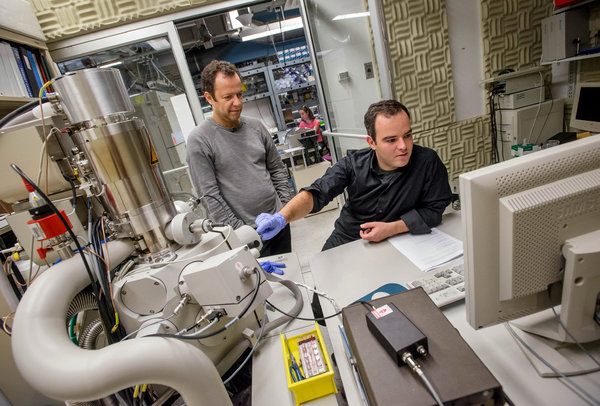
Vik Muniz, left, with Marcelo Coelho. Credit L. Barry Hetherington
Mr. Muniz is among the more than 30 artists, including Tomás Saraceno and Anicka Yi, invited to embed directly in the M.I.T. labs as equals with faculty and students since the creation of the school’s Center for Art, Science & Technology in 2012. It is supported by $3 million in grants from the Mellon Foundation and a recent $1 million gift from the Russian arts entrepreneur Dasha Zhukova for a new artist residency. CAST, as it is known, has revitalized an M.I.T. model begun in the late 1960s of bringing in artists to humanize technology and create more expansive-thinking scientists. M.I.T. is at the forefront of this cross-disciplinary movement with its institutional commitment, but it is drawing on a legacy of artists who are interested in science that dates back to Leonardo da Vinci and that has proliferated as technology has become ever more commonplace and accessible.
Images from “Sandcastles” are on view in Mr. Muniz’s midcareer retrospective of photographs made using unconventional materials and methods at the High Museum in Atlanta. It includes photographs of fluorescent bacteria and cancer cells choreographed into intricate designs from his “Colonies” series, also made at M.I.T. in collaboration with the bioengineer Tal Danino.
“They push the boundaries of what seems to be possible,” said Brett Abbott, the exhibition curator, who is contrasting photographs at microscopic scale alongside Mr. Muniz’s “Earthworks” series, which were drawn at monumental scale with bulldozers and shot from a helicopter. “There’s that moment of transformation where you’re looking at a picture of a motherboard, and all a sudden you realize you’re actually looking at bacteria. These M.I.T. pictures take Vik’s interest in scale and perception to a new extreme.”
Mutually beneficial collaborations have often taken each party into new territories in their fields….
Read the whole article here.
 Organikos
Pingback: If You Happen To Be in Dubai | Raxa Collective