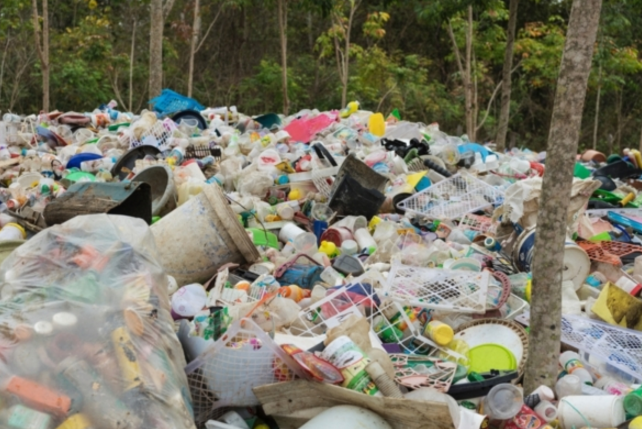
It sounds like the stuff of science fiction – but imagine the impact of a plastic eating bacterium! Thanks to Scientific American for posting this story.
A tiny microbe one day could devour the millions of metric tons of polyethylene terephthalate, or PET, that pile up in landfills each year. Researchers in Japan have discovered the world’s first PET-eating bacterium, a critter that uses PET as its major carbon and energy source.
Each year, plastic manufacturers pump out more than 45 million metric tons of PET to make water bottles, salad domes, peanut butter jars, and other products—all of which sport a stamp with the number one inside a recycle symbol.
PET is the most recycled plastic in the U.S., according to PETRA, the PET Resin Association. But recycling rates still only reach about 31% nationwide. The European Union does better, recycling roughly half of its PET. Even so, tens of millions of metric tons of the plastic wind up in landfills each year, where the polymer’s strong ester bonds resist breakdown.
To find microbes that could pull PET apart, a team led by Kohei Oda of Kyoto Institute of Technology and Kenji Miyamoto of Keio University screened 250 sediment, soil, wastewater, and activated sludge samples from a PET bottle recycling facility in Sakai, Japan. After some careful microbial sleuthing, they found one bacterium that thrived on PET films and named it Ideonella sakaiensis after the city where it was found (Science 2016, DOI: 10.1126/science.aad6359).
 Organikos