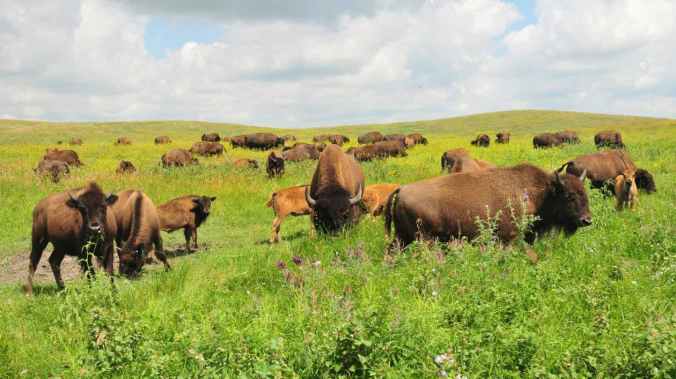
Bison graze on Ordway Prairie, owned and managed by the Nature Conservancy. The site has a USFWS grassland easement protecting it in perpetuity. Photo © USFWS Mountain-Prairie/Flickr
Thanks to science writer Matt Miller, and the Cool Green Science website, we get these stories daily that increase our understanding of the lesser known details of our environment. Are they important? It is a matter of perspective:
Here’s a climate change impact you probably never considered: bison diets.
As the climate warms, bison in North America are likely to shrink, as documented in research published by Joseph Craine and colleagues.
The reason they shrink is because as grasslands warm, grasses and other plants accumulate less protein. Bison are then forced to eat plants that are less nutritious.
This raises a related question: what plants do bison actually eat?
The answer to this question could help conservationists manage for plant species that are higher in protein and preferred by bison – ensuring healthy herds on warming grasslands.
The Bison Story in Context
The near-loss of our bison herds is one of our most-told conservation stories. The great herds were reduced to near extinction, the survivors rescued with no time to spare. Bison have recovered – a remarkable success – but the animals are now scattered in much smaller herds on national parks, nature preserves and ranches.
Not only are there fewer bison roaming the Great Plains, they no longer migrate. Two or three major bison migrations once occurred on North America’s grasslands, on a scale that is difficult to comprehend today.
“Everyone thinks of the Serengeti as the home to a major migration, but it would have been dwarfed by the migration of bison on the Great Plains,” says Craine. “The scale of the plains is huge. Millions of bison would have traveled 1000 miles every year. They moved based on the nutritional quality of plants.”
Today, with most bison in fenced reserves, such movements are not possible. Bison need to meet their nutritional needs within the bounds of that reserve. If grasses with lower protein dominate, the bison have nowhere to move.
But how do bison diets shift in a warming climate? To answer this question, Craine researched actual bison diets in two herds on grasslands that differ in mean annual temperature by 6 degrees Celsius: the Samuel H. Ordway Jr. Memorial Preserve in South Dakota and the warmer Konza Prairie Biological Station in Kansas…
Read the whole article here.
 Organikos
Thank you for this article
You are welcome, thanks for visiting