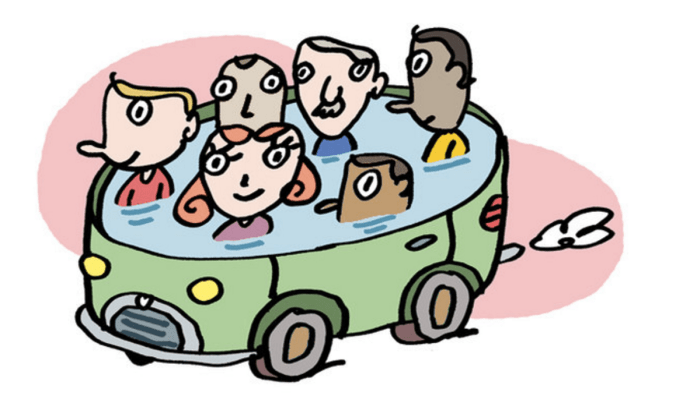
For “baby boomers” the concept of car pooling is a standard one – and not just for over-scheduled kids being taken to after school soccer, dance and music classes. In the mid-20th century fewer people owned a car, and if they did it was one per family, so it was a common occurrence for friends or neighbors to coordinate their morning commutes. Augmented by public transportation, those trips were part of the community fabric.
As the now global Uber app continues to both expand and adapt to the market’s changing demands and needs, it’s possible that UberPool may have both social and environmental impacts.
Unlike a standard Uber ride, in which a single rider starts a one-time trip, UberPool works like a party line for cars. Travis Kalanick, Uber’s co-founder and chief executive, describes it as the future of his company — and thus the future of transportation in America.
Call up the app, specify your destination, and in exchange for a significant discount, UberPool matches you with other riders going the same way. The service might create a ride just for you, but just as often, it puts you in a ride that began long ago — one that has spanned several drop-offs and pickups, a kind of instant bus line created from collective urban demand…
…Mr. Kalanick said it was likely that soon, in big cities and even in many suburbs, most Uber rides will be pooled, meaning each Uber car will be serving more than one rider most of the time.
If that occurs, and if Uber continues growing at its breakneck pace, it would represent a momentous transformation in how Americans get around. Car-pooling was popular in the earliest days of the automobile, but for much of the last 100 years, the numbers have been going in the opposite direction.Today most Americans drive to work alone.
Transportation scholars are now looking into whether car-pooling by ride companies could reverse these dismal numbers. Susan Shaheen, co-director of the Transportation Sustainability Research Center at the University of California, Berkeley, has begun a study with the Natural Resources Defense Council to determine the environmental impact of Uber and Lyft’s car-pooling systems.
Ms. Shaheen said her study, the results of which are due this year, will seek to answer several questions: How many cars are pooled services getting off the roads? Are people using UberPool and Lyft Line instead of public transportation, or are people supplementing public transit instead — for instance, using cars when buses and trains aren’t running? Do cheap Uber rides push people to consider abandoning their own cars? Or if Uber rides are so cheap, are people now more likely to travel when otherwise they might have stayed home?
While that study is in progress, the early data suggests that by getting “more butts in seats” — a phrase that has become a mantra at Uber’s San Francisco headquarters — car-pooled services may already be reducing traffic, gas use and automobile emissions.
Uber has calculated the environmental impact of UberPool rides. In the first three months of 2016, the service has eliminated 21 million automobile miles; that’s about 400,000 gallons of gas and 3,800 metric tons of carbon dioxide emissions, it says. The company says that by reducing prices, the program has also expanded access to Uber.
Critics of Uber’s rise have long feared that cheaper rides could undercut support for public transportation, but a new study by the American Public Transportation Association, a trade group of transit organizations, found the opposite.
Read the entire article here.
 Organikos