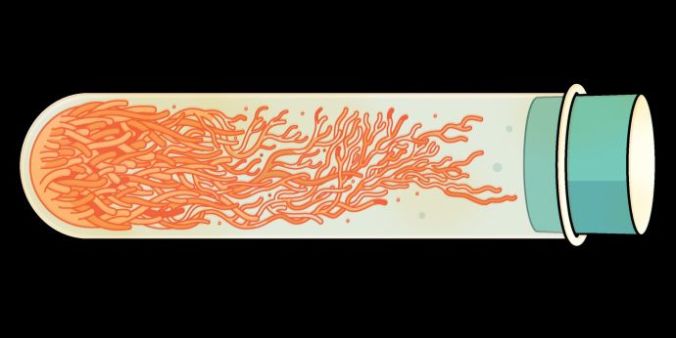
Researchers are hoping to “assist” evolution in order to produce hardier corals and tougher trees. ILLUSTRATION BY HARRY CAMPBELL
We are just browsing through the new edition of one of our favorite weekly sources of material–favored for its variety of topics, and its long form approach–and this Kolbert report hits the right spot for starting a new week with vim and vigor and creative spark:
Unnatural Selection
What will it take to save the world’s reefs and forests?
Ruth Gates fell in love with the ocean while watching TV. When she was in elementary school, she would sit in front of “The Undersea World of Jacques Cousteau,” mesmerized. The colors, the shapes, the diversity of survival strategies—life beneath the surface of the water seemed to her more spectacular than life above it. Without knowing much beyond what she’d learned from the series, she decided that she would become a marine biologist.
“Even though Cousteau was coming through the television, he unveiled the oceans in a way that nobody else had been able to,” she told me.
Gates, who is English, ended up studying at Newcastle University, where marine-science classes are taught against the backdrop of the North Sea. She took a course on corals and, once again, was dazzled. Her professor explained that corals, which are tiny animals, had even tinier plants living inside their cells. Gates wondered how such an arrangement was possible. “I couldn’t quite get my head around the idea,” she said. In 1985, she moved to Jamaica to study the relationship between corals and their symbionts.
It was an exciting moment to be doing such work. New techniques in molecular biology were making it possible to look at life at its most intimate level. But it was also a disturbing time. Reefs in the Caribbean were dying. Some were being done in by development, others by overfishing or pollution. Two of the region’s dominant reef builders—staghorn coral and elkhorn coral—were being devastated by an ailment that became known as white-band disease. (Both are now classified as critically endangered.) Over the course of the nineteen-eighties, something like half of the Caribbean’s coral cover disappeared.
Gates continued her research at U.C.L.A. and then at the University of Hawaii. All the while, the outlook for reefs was growing grimmer. Climate change was pushing ocean temperatures beyond many species’ tolerance. In 1998, a so-called “bleaching event,” caused by very warm water, killed more than fifteen per cent of corals worldwide. Compounding the problem of rising temperatures were changes in ocean chemistry. Corals thrive in alkaline waters, but fossil-fuel emissions are making the seas more acidic. One team of researchers calculated that just a few more decades of emissions would lead coral reefs to “stop growing and begin dissolving.” Another group predicted that, by midcentury, visitors to places like the Great Barrier Reef will find nothing more than “rapidly eroding rubble banks.” Gates couldn’t even bring herself to go back to Jamaica; so much of what she loved about the place had been lost.
But Gates, by her own description, is a “glass half full” sort of person. She noticed that some reefs that had been given up for dead were bouncing back. These included reefs she knew intimately, in Hawaii. Even if only a fraction of the coral colonies survived, there seemed to be a chance for recovery.
In 2013, a foundation run by Microsoft’s co-founder Paul Allen announced a contest called the Ocean Challenge. Researchers were asked for plans to counter the effects of rapid change. Gates thought about the corals she’d seen perish and the ones she’d seen pull through. What if the qualities that made some corals hardier than others could be identified? Perhaps this information could be used to produce tougher varieties. Humans might, in this way, design reefs capable of withstanding human influence.
Gates laid out her thoughts in a two-thousand-word essay. The prize for the contest was ten thousand dollars—barely enough to keep a research lab in pipette tips. But after Gates won she was invited to submit a more detailed plan. Last summer, the foundation awarded her and a collaborator in Australia, Madeleine van Oppen, four million dollars to pursue the idea. In news stories about the award, the project was described as an attempt to create a “super coral.” Gates and her graduate students embraced the term; one of the students drew, as a sort of logo for the effort, a coral colony with a red “S” on what might, anthropocentrically, be called its chest. Around the time the award was announced, Gates was named the director of the Hawaii Institute of Marine Biology.
“A lot of people want to go back to something,” she told me at one point. “They think, If we just stop doing things, maybe the reef will come back to what it was.”
“Really, what I am is a futurist,” she said at another. “Our project is acknowledging that a future is coming where nature is no longer fully natural.”
The Hawaii Institute of Marine Biology occupies its own tiny island, known as Moku o Lo‘e, or, alternatively, Coconut Island. In the nineteen-thirties, Moku o Lo‘e was bought by an eccentric millionaire who fashioned it into an insular Xanadu. He installed a shark pond, a bowling alley, and a shooting gallery, and threw elaborate parties with guests like Shirley Temple and Amelia Earhart. After falling into decline, Moku o Lo‘e was rediscovered by Hollywood in the nineteen-sixties. TV producers used it in the opening sequence of “Gilligan’s Island.”
There’s no public transportation to Moku o Lo‘e, which sits off the windward coast of Oahu, in Kaneohe Bay. Visitors just show up at a dock, and the institute’s boatman, provided he is expecting them, will motor over. “Gilligan” fans will be disappointed to learn that the journey takes about a minute and a half…
Read the whole article here.
 Organikos