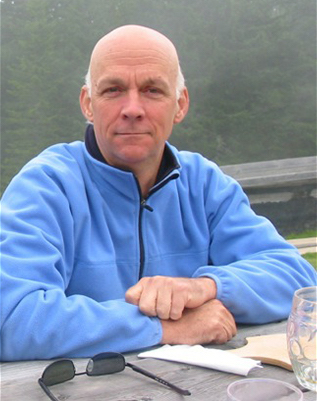
Photo courtesy of William Clark. William Clark, Harvey Brooks Professor of International Science, Public Policy, and Human Development at Harvard Kennedy School, has co-authored a new book on sustainability. “Achieving more equitable and sustainable use of the Earth requires a great deal of working together,” he said.
Thanks to the Harvard Gazette for this interview with William Clark:
Pursuing sustainability
A Q&A on connecting science and practice, balancing conservation with use
By Amanda Pearson, Weatherhead Center Communications
United Nations Secretary-General Ban Ki-moon on Friday will welcome 130 heads of state who have pledged to sign the Paris Agreement, the global agreement on managing climate change. For William Clark, Harvey Brooks Professor of International Science, Public Policy, and Human Development at Harvard Kennedy School (HKS), sustainability is a global imperative and a scientific challenge like no other.
Clark sees the Paris Agreement as just one step, though an important one, in this urgent pursuit, as officials wrestle with how to meet the needs of a growing human population without jeopardizing the planet for future generations. He and co-authors Pam Matson of Stanford University and Krister Andersson of the University of Colorado at Boulder tackle that issue in a new book, “Pursuing Sustainability: A Guide to the Science and Practice.” By looking at sustainability as a means of alleviating poverty and enhancing well-being, the book highlights the complex dynamics of social-environmental systems, and suggests how successful strategies can be shaped through collaborations among researchers and practitioners.
Clark, who trained as an ecologist, said that while exhausting Earth’s natural resources would jeopardize future generations, sustainability could counter that. The goal is to find a healthy equilibrium between human adaptation and natural evolution. Clark, the co-director of the Sustainability Science Program at HKS, spoke with the Weatherhead Center for International Affairs about building a more sustainable future.
GAZETTE: The terms “sustainability” and “sustainable development” are used in many different contexts. How have these terms evolved?
CLARK: The framework we build up in this book starts with the core idea of sustainable development as articulated by Dr. Gro Brundtland in the “Report of the World Commission on Environment and Development” [presented to the U.N. General Assembly in 1987]. It’s interesting that the report never used the word “environment” in its canonical definition of sustainability. Rather, they concluded that “humanity has the ability to make development sustainable: to ensure that it meets the needs of the present without compromising the ability of future generations to meet their own needs.” It wasn’t that they didn’t think environment was important, but they understood that in many senses the environment was a means to an end. The end was improving people’s lives — people’s lives here and now, but not at the expense of future generations, and not at the expense of people on the other side of the fence on whom you throw your garbage.
GAZETTE: So 30 years ago the Brundtland Commission recognized the importance of sustainable energy and sustainable management of forests. But doesn’t sustainable development today have a much broader agenda? How did it evolve?
CLARK: Certainly environmentalists were behind the initial push for sustainability issues. But environmental scientists in the scholarly community also constituted some of the most enthusiastic cheerleaders for the Brundtland Report. So the sustainability movement became a very green movement — protect the forests, protect land from soil erosion, and so on. It became very easy to lose track of the fact that the World Commission on Environment and Development — to its eternal credit — did not just sit in offices in Geneva or Washington, but went around the world meeting with people in cities, in towns, in poor communities, in rich communities, asking about people’s concerns for the future. What they learned was that people were ultimately concerned about people — their own well-being as well as that of their grandchildren and neighbors — but that many understood that environmental stewardship was an essential, if often neglected, means for achieving such inclusive human well-being.
GAZETTE: Did the World Commission on Environment and Development set a new precedent for integrating policy-making with input from scientists?
CLARK: Emphatically, yes. This was a group of essentially politically attuned people. There were no “techies” on the Brundtland Commission — and by techies I mean scientists, academics, researchers. The members were all recruited because of their experiences in the world. Dr. Brundtland’s view was that if we can get the political and business leaders on board, then we’ve got something that can move to a high level on the international agenda, at which point the techies will be essential to help us achieve our politically defined goals.
GAZETTE: The Paris Agreement is supposed to add structure to current global efforts to reduce greenhouse gas emissions. In some ways it seems that human well-being used to be secondary to planetary health, when really the two are inseparable.
CLARK: Right. Brundtland recognized that if we started with the techies, they’d be providing all sorts of potentially useful pieces to the sustainability puzzle, but they wouldn’t frame the whole picture and wouldn’t gain the endorsement of the international political community. After the Brundtland Commission reported in 1987, scientists seized their opportunity to begin fleshing out the sustainability agenda, a lot of which became about greening. None of that is wrong, but in many ways it lost some of its top table legitimacy in the political realm. Why should a country on the edge of starvation join an international movement on greening? After all, people in such countries already know (better than we do) that you need to treat your environment carefully because that’s the source of most of a poor person’s wealth and resources.
GAZETTE: What was the next phase in the evolution of sustainability thinking? What was the shift from greening to linking Earth’s health with human well-being?
CLARK: Scholarship advocating a return to thinking of sustainability in terms of human well-being began to re-emerge over the last 15 to 20 years with strong contributions from the World Bank and the U.N. organizations. They began by pushing for a reformulation of how we should think about human progress and its barriers, framing things around this idea of well-being. Human well-being was something that people have always thought about. But these scholars — David Pearce, Kirk Hamilton, Karl-Göran Mäler, and, above all, Partha Dasgupta — brought well-being back into the middle of the sustainability debate. From this campus, Nobel laureate and Weatherhead Center faculty associate Amartya Sen extended the notion of well-being to encompass dimensions of human capabilities and freedom.
GAZETTE: What is a good analogy for the concept of “core assets” that you write about in “Pursuing Sustainability”?
CLARK: There’s an analogy I use in my Sustainable Development course at Harvard College. When you’re flying in an airplane across the Atlantic, they dutifully feed you information on two of the three important points about your flight. One, is the plane flying in the right direction toward your chosen destination? Two, they tell you of the airplane’s speed, so you will know whether you are getting to your destination reasonably fast. What they don’t tell you is the third piece of information, which you just assume someone in the cockpit is thinking about: Does the plane have enough fuel to reach the chosen destination on the chosen course at the chosen speed?…
Read the whole interview here.
 Organikos