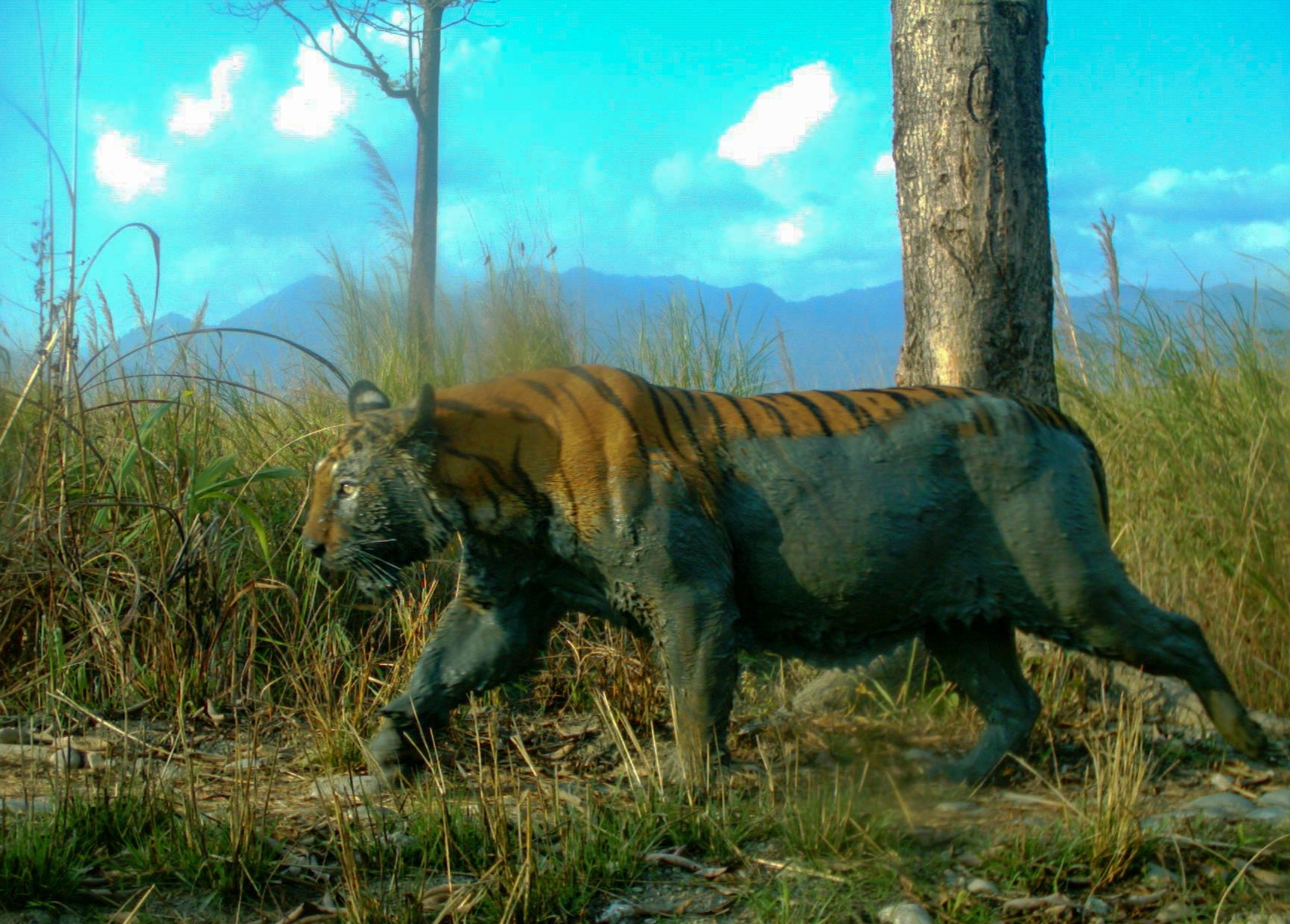
This tiger has emerged from a cooling mud bath at Manas National Park in India. Researchers can identify individual tigers based on their unique array of stripes. Credit: WWF-India. Courtesy of “Candid Creatures: How Camera Traps Reveal the Mysteries of Nature,” by Roland Kays (May 2016, Johns Hopkins University Press
Once again, Science Friday has come through with a cool article about an interesting subject. It contains excerpts from a new book containing images from camera traps, which are good research tools for animals that try to avoid humans. We’ve featured the devices a lot as a result, and now we get to continue doing so. Julie Leibach reports:
A new book of unabashed selfies has been released, but it reveals neither hide nor hair of a Kardashian. There is, however, plenty of hide and hair. Candid Creatures: How Camera Traps Reveal the Mysteries of Nature, by zoologist Roland Kays, is an album of wildlife photos captured with camera traps—devices that researchers install in the field to record members of the animal kingdom as they lope, scamper, or climb about their business. Kays’ book is also a rich summary of the insights that scientists have gained from using these tools.
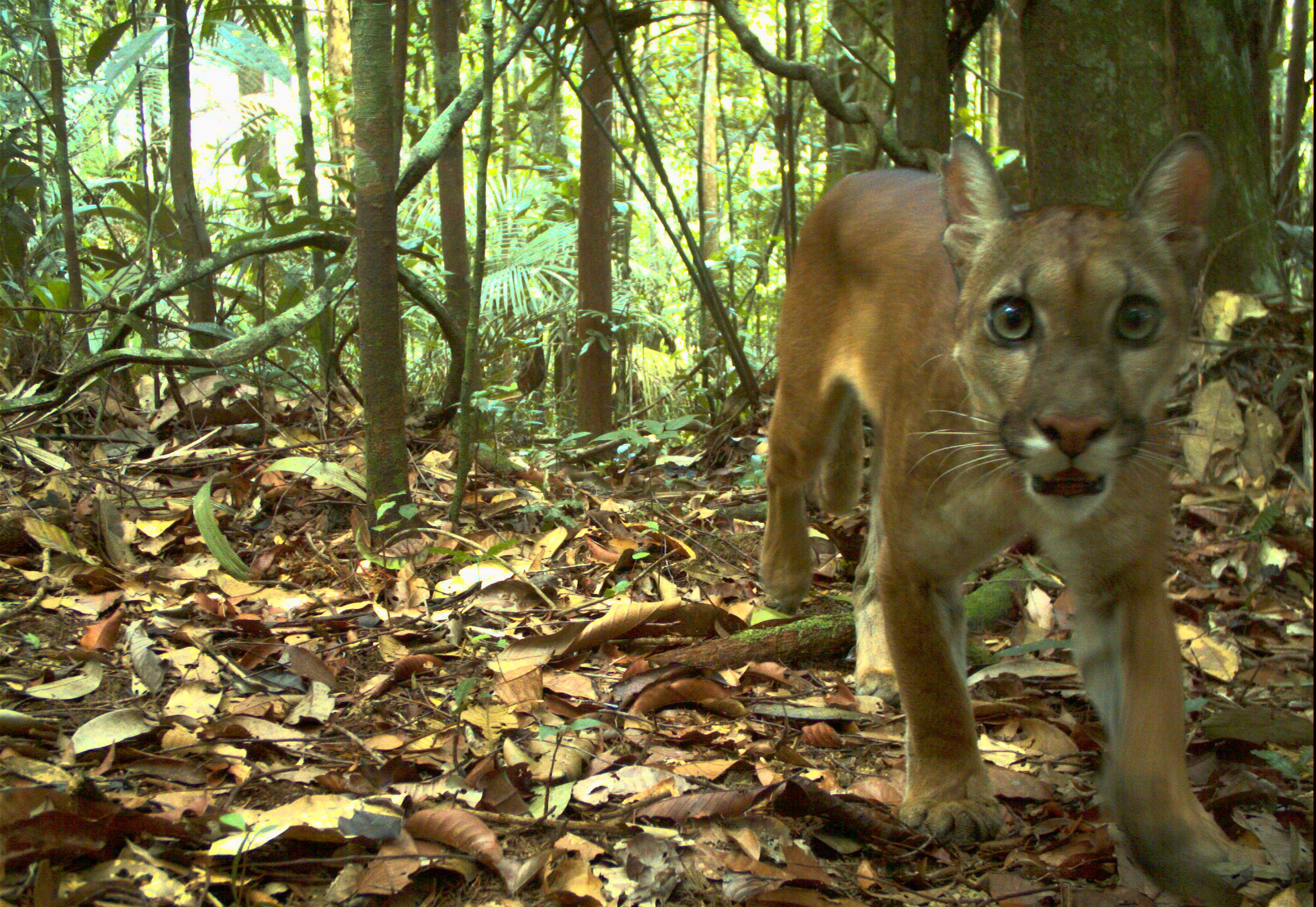
A camera trap in Manaus, Brazil, captures a cougar by surprise. Credit: TEAM Network and the Brazilian National Institute for Amazonian Research, Manaus, Amazon State, Brazil. Courtesy of “Candid Creatures: How Camera Traps Reveal the Mysteries of Nature,” by Roland Kays (May 2016, Johns Hopkins University Press)
In essence, modern camera traps work like this: When a warm-blooded animal (or a reptile heated by the sun) walks in front of the device, an infrared motion-sensing component detects a change in heat signature, which triggers a digital camera to snap a photo. It’s then up to the researchers to recover the memory card containing the footage.
“It’s kinda like Christmas every time you open the camera trap and get to see what pictures you get,” says Kays, a research associate professor at North Carolina State University and the director of the Biodiversity Lab at the North Carolina Museum of Natural Sciences, who often uses camera traps in his work.
“Of course, there are millions of crappy pictures of animal butts,” he concedes, but when you hit upon a great shot of, say, a coyote in the middle of a frame, “you’re like, ah, that’s cool.” For Candid Creatures, Kays compiled what he calls the “greatest hits” of global camera trapping efforts, consisting of more than 600 photos from 153 research groups, including his own.
The pioneers in camera-trap research were scientists studying felids, or cats. “It was all about the tigers and the jaguars and these big species that were so endangered and so impossible to study any other way,” says Kays. Using camera-trap images, researchers can identify individual cats from their unique markings, enabling them to “estimate densities and numbers of animals and count them and track them over the years,” says Kays.
But these days, zoologists, field biologists, and even citizen scientists employ camera traps to spy on all sorts of animals, for various reasons. For instance, the footage might help them better understand the mere presence of species in an area, or how wildlife uses a certain resource, such as vegetation or a highway overpass.
Read the rest of the article here.
 Organikos