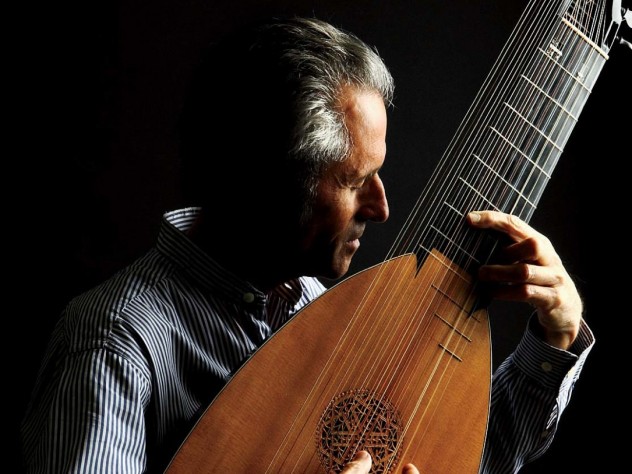
Hopkinson Smith playing the German theorbo built for him by Joel van Lennep. Photograph by Philippe Gontier/Courtesy of Hopkinson Smith
When a musician of this talent dedicates his life to mastery of instruments that keep an old tradition alive, we take notice. When he describes J.S. Bach as a recycler, we understand in a fresh context the value of this concept that we tend on these pages to relegate to the reduction of waste. Recycling is also about adaptation, evolution, improvement (thanks to Harvard Magazine):
HOPKINSON SMITH ’70 describes J.S. Bach as a musical ecologist. “He recycled so many of his own works,” Smith explains. “He never stopped trying to adapt what he’d written.” It was an accepted musical practice at the time, but one imagines the composer was driven at least in part by pragmatism: his posts in a number of German cities required him to produce new compositions at a fierce pace. Refashioning musical materials helped him keep up with those demands. “Even so,” Smith adds, “writing a cantata a week would not have been a manageable task for the rest of us mortals.”
As a lutenist, Smith has had to contend with the Baroque composer’s propensity to repurpose. Bach wrote little for the instrument, mostly transcriptions of existing works. Smith’s latest recording is a collection of Bach’s Sonatas and Partitas (BWV 1001–1006), six pieces ostensibly for violin, and the Suites (BWV 1007-1009, 995, 1010, 1012), widely recognized as scored for cello. But as Smith writes in his liner notes for the violin sonatas,“[T]he music is conceived on such an abstract plane that the score already appears to be a kind of adaptation” from a theoretical ideal. Bach’s arrangements highlight a rigor and logic to his compositions not rooted in individual instruments but able instead to transcend them.
Smith himself has always possessed a polymorphous musicality. Growing up, he played electric guitar, banjo, and mandolin, and in high school, he remembers, “I’d learn how to play whatever they needed in the band, without a teacher.” It was the 1960s, and Smith, inspired by the likes of the New Lost City Ramblers, delved into folk and Appalachian music. “Then I latched on to classical guitar—or it latched on to me. It was clear what I wanted to do, and there was no looking back, and there was no choice.”
That is, until he discovered the lute in college. For three semesters at Harvard, he studied with musicologist John Ward, who specialized in the repertoire for Spanish vihuela (a Renaissance guitar that Smith has also mastered) and English lute. Smith’s attraction to the lute was fourfold: “It was the sound and shape of the instrument, in addition to the incredible quality and quantity of the different repertoires from different regions and different eras.”
He found ready opportunities to play within Boston’s incipient early-music scene. Upon graduation, he opted to study for a year at the prestigious Schola Cantorum in Basel, Switzerland, where he’s lived ever since; Smith likens it to “stepping out of the Middle Ages and into the Renaissance.” The burgeoning community there included the late vocalist Montserrat Figueras and her husband, viol player Jordi Savall, with whom Smith performed and, in 1974, officially founded Hesperion XX, arguably the most acclaimed early-music ensemble of all time. The performers’ imaginative yet scholarly approaches breathed life into Hispanic and European repertoires from before 1800, music that had been all but forgotten. Smith performed with the ensemble until the mid 1980s, when, he says with good humor, “Hesperion’s projects got bigger and bigger and I got smaller and smaller.”
In Renaissance repertories, the lute elaborates on the written lines in ensemble music…
Read the whole article here.
 Organikos