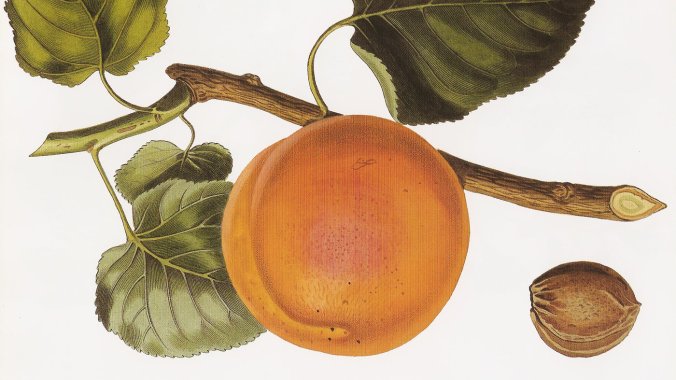
The ‘Turkey’ apricot, a hand-coloured engraving after a drawing by Augusta Innes Withers (1792-1869), from the first volume of John Lindley’s Pomological Magazine (1827-1828). The Romans dubbed the apricot the “precious one.” Poets praised its beauty. The conquering Arabs took it to the Mideast, where the luxurious fruit was exploited in sugary confections. The Royal Horticultural Society Diary/Wikimedia Commons
Thanks to National Public Radio (USA) and the Salt folks:
‘Moon Of The Faith:’ A History Of The Apricot And Its Many Pleasures
The Romans dubbed it the “precious one.” Poets praised its beauty. The conquering Arabs took it to the Mideast, where the luxurious fruit was exploited in sugary confections.
Four radiant, yellowish-orange apricots were depicted on each of the cellophane packages stacked on a shelf in a Middle Eastern grocery near my home. An avid fan of dried apricots, I was drawn to the sheets of dried apricot paste imported from Damascus. Amardine, as it is called, is especially beloved in the Ramadan season, when it is used to make a juice that the faithful drink to break their fast or to savor during the festive time after sundown.
Translated into poetic Arabic, amardine means “moon of the faith.” It is unlike your ordinary supermarket fruit roll that some call “shoe leather.” According to Charlie Sahadi, owner of a vast Middle Eastern food emporium in Brooklyn, the Arabic delicacy has a “thickness” and “consistency” that ordinary fruit rolls lack.
The apricot, which was cultivated in China and Central Asia as early as 2000 B.C., migrated with the country’s traders, who traveled the Great Silk Road. The Chinese merchants, botanist Berthold Laufer suggests, very probably introduced the fruit to the Persians. They called it the “yellow plum” (zardaloo). Widely dispersed, it was spread throughout the Eurasian steppe by nomadic, horseback-riding tribesmen.
This member of the rose family, whose relatives include the plum, peach, cherry and almond, is known botanically as Prunus armeniaca, a reference to the land from which the ancient Greeks believed it came. The Romans, who learned of the apricot in the first century A.D., dubbed it praecocum, the “precocious one.” They noticed that the fruit bloomed early in the summer. A sensitive plant, it was easily injured by early frost or strong winds. The fragile fruit has long been a favorite of royals and aristocrats. The apricot’s beauty captivated poets like English writer John Ruskin, who described it “shining in a sweet brightness of golden velvet.”…
Read the whole article here.
 Organikos