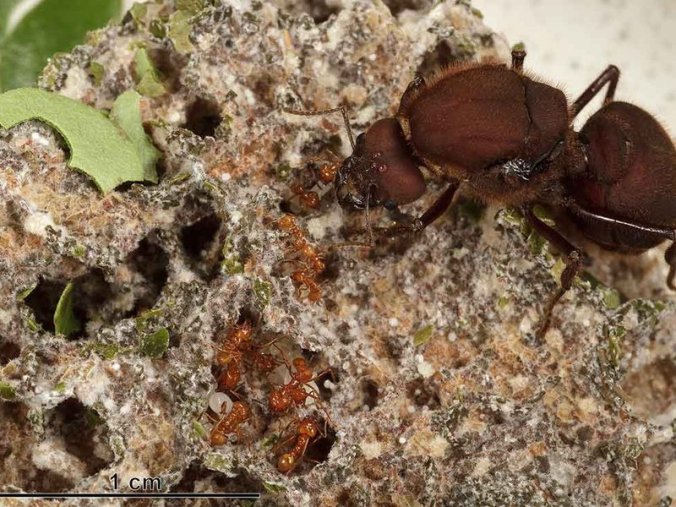
Tiny nurse ants tending to white ant larvae are dwarfed by the queen ant in the upper right. All the ants feed upon protein-rich food produced by a white-grey fungus that they cultivate underground. (Karolyn Darrow)
Thanks to the folks at Smithsonian for this one:
Were Ants the World’s First Farmers?
A new study shows that a group of ants have been conducting a subsistence type of farming since shortly after the dinosaurs died out
By Jackson Landers
Humans have been practicing agriculture for about 10,000 years. But the attine ants of South America (which include the well-known leafcutters) have us beat by a long way.
According to a new paper co-authored by entomologist Ted Schultz, curator of ants at Smithsonian’s National Museum of Natural History, attine ants, which farm on an industrial scale similar to humans, have been carefully cultivating gardens with a complex division of labor to grow an edible fungus. Schultz’s team found that the ants have been doing this far longer than previously believed—up to 65 million years—and that we have much to learn from them.
Schultz and his co-authors, led by by Sanne Nygaard, Guojie Zhang and Jacobus Boomsma of the University of Copenhagen, conducted an analysis of the genomes of the various species of attine ants as well as the fungus that they cultivate. Their results answer some long-standing evolutionary questions.
The 210 species of attine ants, including the 47 species of leafcutters, forage through the forests of Central and South America in search of leaves and other vegetation, which they carve into pieces using their powerful jaws and carry back to their nests. But they never eat the leaves directly. The plant matter is used as a growth medium for certain varieties of edible fungi which Schultz’s team says have been cultivated and passed on by generations of ants going back tens of millions of years.
When a group of hunter-gather ants in South America eons ago switched to eating fungi, ant farming began to evolve.
Schultz says that the ancestral switch from a hunter-gatherer lifestyle to agriculture was probably irreversible. Many genes disappeared from the ants as they made the transition.
“It looks like possibly shortly after the ancestor of these ants started cultivating fungi, the ant lost the ability to make one of the amino acids, arginine. So the idea is that it depends on the fungus for that amino acid. . . .They probably can’t go back.”
While arginine is found in meat and in many plants, the need to find sufficient wild sources of the amino acid could make it difficult for the ants to give up their dependence on the fungi that uses the ants just as much as the ants use the fungi.
“When I first started doing this, the way we thought of it was ant farmers are like little humans,” Schultz says. “And we’re pretty sure that we’re in charge of our crops. When I started working with mycologists, they had a different take on it. The fungal colony is sending out the ants to bring back food. I tend to think of it as nobody’s in control. It’s a symbiosis and selection is acting on the combination.”…
Read the whole story here.
 Organikos