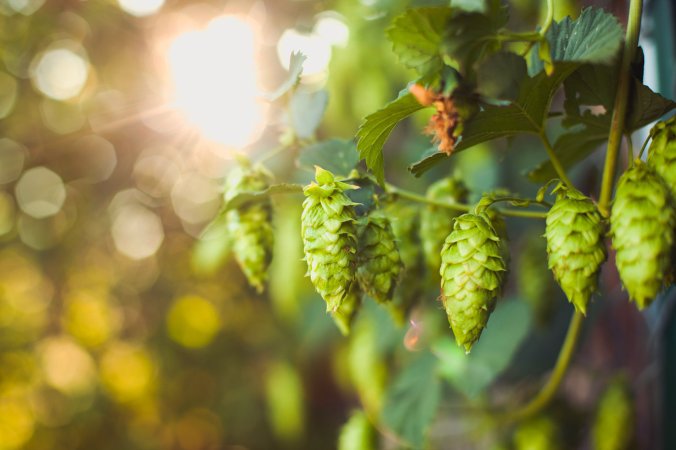
Ripe summer hops good for making beer. Tim Newman/Getty Images
We are anticipating another post by one of our authors, on a topic related to this news story below (thanks to NPR’s great special section, the salt), so let this serve as a reminder and a harbinger:
Hop Growers are raising a glass to craft brewers. The demand for small-batch brews has helped growers boost their revenues, expand their operations, and, in some cases, save their farms.
“Without the advent of craft brewing, a few large, corporate growers would be supplying all of the hops and local, family owned farms like ours would have gone bankrupt,” says Diane Gooding, vice president of operations at Gooding Farms, a hop grower in Wilder, Idaho. “It’s saved the industry.”
When Gooding came to work on her sixth-generation family farm in 2010, Gooding Farms grew four varieties of hops on 350 acres; the entire crop was sold to a single dealer that processed them for resale to big beer companies.
Over the past six years, the farm has expanded to 13 varieties of hops and 600 acres; the customer base has expanded, too. Gooding Farms supplies hops to 12 different accounts; the majority of their harvest is sold to local and regional breweries.
“It’s a much more dynamic customer base for us,” Gooding says. “Now that there is more demand than supply, prices are going up and we’ve been able to reinvest in the farm for the first time since the ’80s.”
Brewing demand
The thirst for craft beer has exploded. In 2015, the Colorado-based Brewers Association reported a 12.8 percent increase in craft-beer sales (compared to 0.2 percent for beer sales overall) and estimates the market at $22.3 billion—about one-quarter of the total U.S. beer market.
Craft brews use more hops than traditional lagers produced by large brewing companies, which accounts for the surge in demand. Unlike big breweries, where hops are used to give beer its bitterness, craft breweries use “aroma” varieties of hops that have less acid (and impart less bitterness); each of the different varieties add a distinct flavor to the beer.
Craft beers contain up to five times more hops than traditional beers. The result, according to Jaki Brophy, communications director for the trade association Hop Growers of America, is “a huge impact” on commercial hop growers.
In 2016, there are 53,213 acres of hops growing nationwide—the most acreage ever in production and an 18.5 percent increase over 2015. Almost all of the hops production is in Washington, Oregon and Idaho but 29 states are registered to grow the crop. Although there has been significant consolidation in the industry—the number of commercial growers decreased from 378 in 1964 and 90 in 1987 to just 44 in 2015, according to Hop Growers of America—new growers are coming online all the time.
Raising a glass to brewers
Ryan Hammer started growing hops in 2012. His first harvest from the quarter-acre parcel of land in Knightstown, Indiana, was sold to Sun King Brewing in Indianapolis.
“Craft brewers in Indiana were making local beers with hops from thousands of miles away,” Hammer explains. “When I started growing hops locally, the brewers loved it and wanted me to grow more.”…
Read the whole story here.
 Organikos