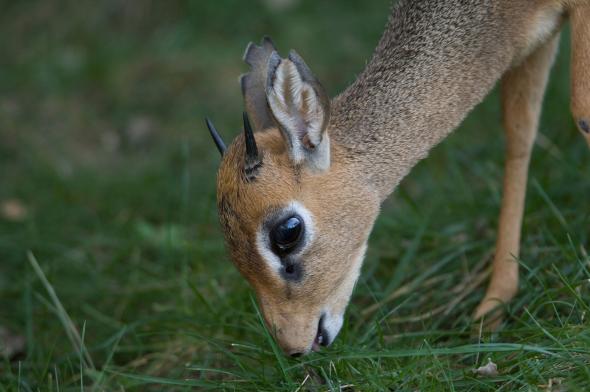
A dik-dik, a type of dwarf antelope with tiny horns. All photos by National Geographic
Horns are a curious biological development that come in all shapes and sizes and serve different purposes. There are plenty of white-tailed deer around the Gallon Jug Estate, some of which are young bucks with anywhere from one- to five-point antlers, and last night two guests actually watched a pair of these males butting heads within Chan Chich Lodge. An article by National Geographic enlightens us to the horny way of life:
Horns evolved independently in many animals to meet similar needs—first as weapons, and then as defenses against rivals, says Don Moore, director of the Oregon Zoo in Portland.
Horns likely initially inflicted body blows, but became larger and more elaborate as they absorbed blows to the head. This strategy led some animals, like pronghorns, to essentially wrestle (watch a video), whereas others, like sheep, ram their opponents.
Horns can also communicate power—big ones, for instance, may identify a herd’s dominant male so that newcomers can avoid fighting him and risking injury, Moore says.
Dangerous Curves
Male horns may also attract females looking for the strongest mate, though in most ungulate species, females also have horns, says Patrick Bergin, chief executive officer of the African Wildlife Foundation. The beautifully striped bongo is one example, he says.
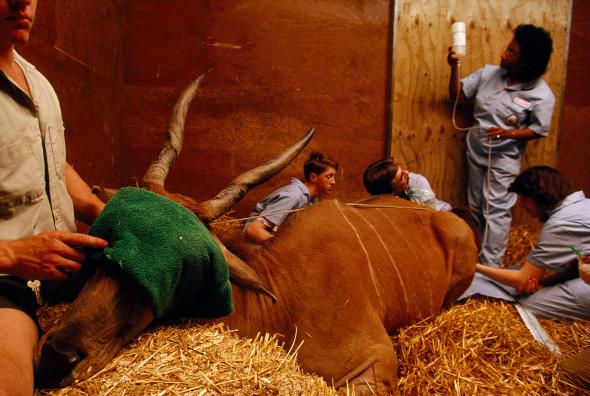
Cincinnati Zoo staff collect the eggs of a giant eland to help with reproduction of the species in Africa.
Species with horned females are usually large and live in open areas, making it difficult to camouflage themselves and likely driving the evolution of their weaponry. They’re often species in which females fight each other for territory, according to a 2009 study.
In particular, Africa’s “diverse ecological niches” sustain a huge variety of hoofed animals with many different horns, Bergin says.They range from the jackrabbit-size dik-dik, with three-inch (eight-centimeter) horns, to the giant eland, whose curling horns can reach nearly four feet (just over a meter).
It’s not always clear whether horns help African animals in their habitat, but scientists have some clues. The nyala, for instance, may use its spiraled horns to move brush aside and help the shy creature hide.
The red forest buffalo’s horns are “smaller, tighter to the head, so they can move through the forest” easily, Bergin says.
That’s not the case for the Cape buffalo, whose grassland lifestyle allows for big, curved horns. The horns sometimes grow so large they fuse in the center, creating “one big solid plate of horn” called a boss. It can be quite a defense in a fight with a lion, Bergin adds.
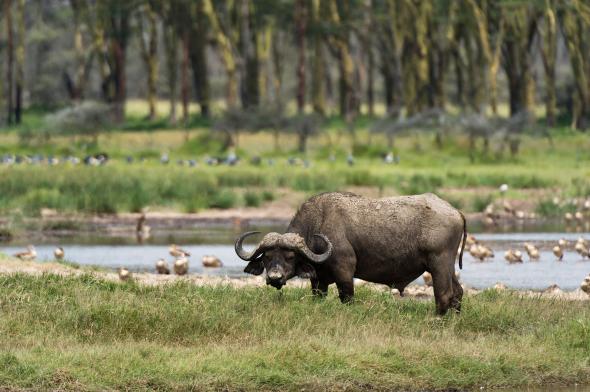
Cape buffalo horns grow so large they fuse in the center, creating one solid plate, called boss.
Some horns carry some useful information—Africa’s walia ibex and Europe’s Alpine ibex both have three-foot (nearly a meter long) horns whose rings reveal their ages.
Continue reading the full article here.
 Organikos