
Glad to see chefs in South America leading this innovative form of entrepreneurial conservation, and crossing country borders to do so:
Bolivian national park serving up sustainable ingredients for fine dining
Chefs among travellers proving there is demand for produce from Madidi – and helping communities understand commercial potential of their flora and fauna
Deep in Bolivia’s Madidi national park, Kamilla Seidler – the head chef of the Gustu restaurant in La Paz – was looking at a basket of cusí, the fruit of the babassu palm. An oil processed from the seeds is already marketed as a hair and skin product, but Seidler suspected it could have culinary potential, too.
“Bring me three kilos of it and in a month I can tell you all kinds of things you can do with it,” she told Agustina Aponte, who was representing a group of women from Yaguarú, one of 31 campesino and indigenous communities living within Madidi’s 1.89m hectares.
While the Bolivian government is pushing to open its protected areas to oil and gas firms, the women had come to participate in an initiative to exploit the park’s natural resources in a more sustainable – and appetizing – way.
Chefs from across Latin America, scientists from the Wildlife Conservation Society, and staff from Bolivia’s environment ministry and the Danish International Development Agency had also travelled to the park to discuss sustainable rainforest products.
The meeting was intended to prove that there is demand among leading chefs for forest produce such as wild cacao or oreja de mono mushrooms – but also to help native communities understand just how much commercial potential there is in the flora and fauna they come across on a daily basis.
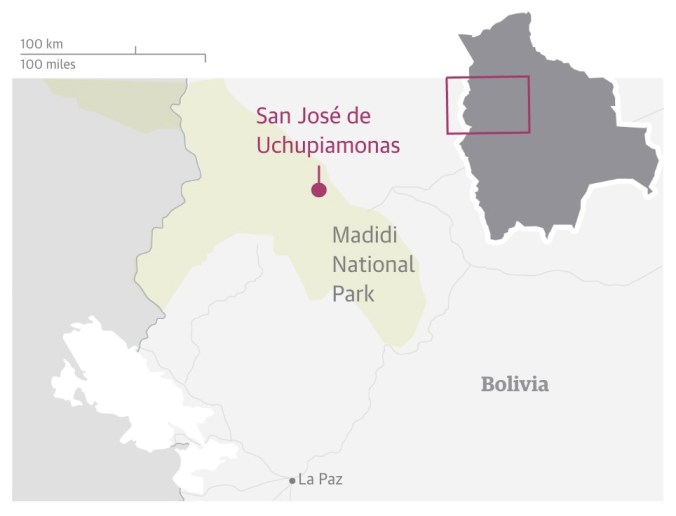
“The first thing we have to do is document the biodiversity. To understand what is there,” said Rob Wallace, of the Wildlife Conservation Society (WCS), who has been exploring the protected area for the past 17 years.
Wallace and his team have catalogued more plant and animal species in Madidi than any other national park in the world, identifying those that are edible with the help of native guides.
Out of the forest came camu camu (a cherry-sized fruit with 30 times the vitamin C of an orange) and majo (another palm fruit that can be pressed to produce a milk, which could offer an alternative for the lactose intolerant). There was rare wild cacao and the honey from stingless bees. Some arrived in carefully labelled boxes, others in old Coca-Cola bottles…
Read the whole article here.
 Organikos