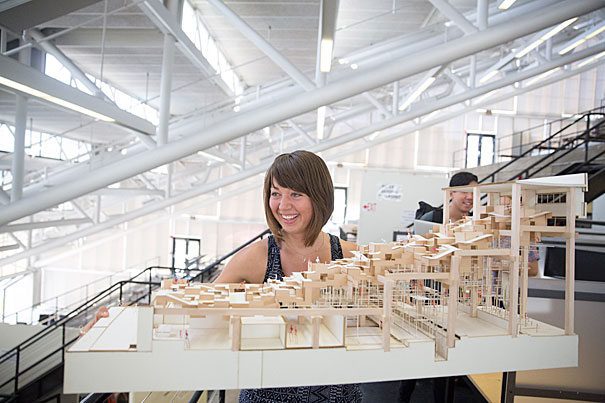
Harvard Graduate School of Design PhD student, Lauren Friedrich’s thesis researched how architecture can facilitate physical well being and what that means for workplace design. Here she is seen in Gund Hall with her model of proposed Gund Hall renovations. Harvard University. Kris Snibbe/Harvard Staff Photographer
Because design is frequently part of the assignments we take responsibility for, we monitor our reading lists for interesting stories about architecture, about interior spaces, about how these impact our experiences; and here is a worthy pick. It reminds us of the creative crew we had with us in India a few years back:
Design for movement
Graduate thesis explores changing relationship between architecture and healthy living
By Christina Pazzanese, Harvard Staff Writer
At a basic level, architecture is like a shoe: a useful tool designed to protect the human body from harm caused by the natural elements.
Yet over time, we can become over-reliant on its comfort, losing our dexterity and our ability to withstand even the slightest discomforts. So what is meant to help us may, in fact, hinder us by making things too easy, removing all physical challenges and other stressors that are essential for optimal health.
It doesn’t have to be that way, says Lauren Friedrich, a 2016 graduate of Harvard’s Graduate School of Design (GSD). What if instead of disconnecting the human body from the man-made landscape, architectural design used creativity and reorientation to create spaces that challenged our physical skills and encouraged, rather than minimized, a range of movements that supported better health?
That’s the question Friedrich set out to explore in her master’s thesis, a project that takes a multidisciplinary approach incorporating insights from experts across Harvard in neuroscience, biomechanics, physical therapy, choreography, and ergonomics, and ideas from people who patronize public spaces. Her thesis also cleverly reimagines GSD’s Gund Hall as a flexible fun house full of passageways that encourage circulation and “resting nets.” The Gazette spoke with Friedrich about her novel research.
GAZETTE: How did you become interested in the relationship between architecture and the human body?
FRIEDRICH: Over the past two years, I have grown immensely interested in what shapes the human body, whether it is the food that we eat or the way that we move. Despite the fact that individuals tend to excuse their physical shortcomings — lack of strength, poor balance, horrible coordination, embarrassing flexibility — on lack of time, lack of access to a gym, or genetics, I couldn’t help but question whether the built environment, arguably where we spent most of our time, was to blame.
GAZETTE: What did you set out to study?
FRIEDRICH: Before I could even consider designing, I set out to fully understand what the problem was and why it was occurring. Realizing early on that architectural history touched little on movement and how movement shapes the physical body, I began to explore fields that would have a stronger perspective. I spoke with physical therapists, bio-mechanists, ergonomists, dancers and choreographers, physical trainers, educators, and scientists. More importantly, I spoke with regular people, people who sit and work at desks all day, people who stand up all day, people who commute by bike and others who commute by bus, people who go the gym regularly, and those who don’t go at all. I was intrigued by the responses, by the genuine questions and curiosities, and by the excitement I triggered for the possibility of an environment different than we’ve grown so accustomed to.
I learned through this research that the body is shaped more by how we move than by how much we move. So, I dove into neuroscience to understand how we move. The brain is programmed to repeat behaviors and to adapt quickly to its environment. Unfortunately, when the body adapts, it stops sending sensory signals to the brain. Just as routines place us in automatic-pilot mode, severing the conscious ties between the brain and the movements being performed, repeated movements change the physical body on a cellular level, reshaping the muscles, tissues, and bones to best accommodate the behavior. The result is a body that is narrowly adapted to its environment. An example of this would be sitting at a desk all day, shoulders hunched forward, spine curved, with all of the body’s gravity being loaded onto the chair. Because no muscles are being engaged for stabilization, they either tighten up or atrophy. Even when that body stands up, the spine will keep the curve and the muscles will strain.
Similarly, if the hip is only ever required to extend to a certain degree of flexion when walking upstairs, it will lose its ability to reach full flexion. So, I advanced into designing an environment that engages the full body with three main movement parameters: to stress the body beyond what it’s accustomed to, to progressively adapt the body to these new stressors, and to vary the movements being performed…
Read the whole interview here.
 Organikos