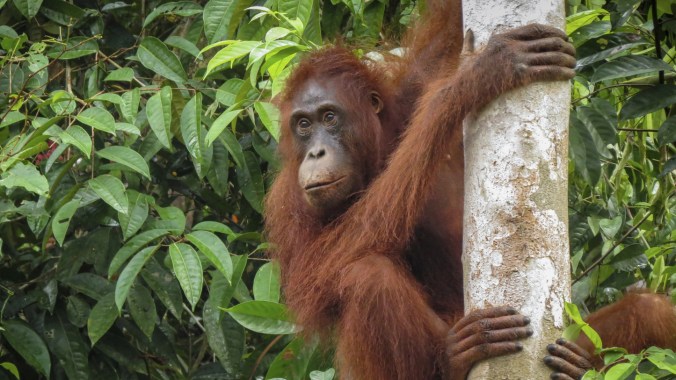
An orangutan in Tanjung Puting National Park in Borneo, Indonesia. All photos from: The Nature Conservancy
About a week ago we celebrated World Lion Day. Today we celebrate a different, long-limbed animal that likes to climb trees, the Orangutan. There are two species of this magnificent arboreal ape, both of which are facing potential extinction due to deforestation, poaching, the illegal pet trade and forest fires. As of last month, the status of the Bornean orangutan was classified as “critically endangered,” but conservationists are not giving up and are taking significant measures to improve forest management by working together with local communities and developing public-private partnerships.
The harmony between humans and apes began to unravel with the arrival of European explorers, who hunted them extensively during the 19thcentury. But it was not until the mid-20th century that human activities began to imperil orangutans’ existence. Extensive deforestation not only directly threatened orangutan habitat, it made the forest more easily accessible to humans. This led to both conflicts with orangutans, as the apes will eat crops, and made it easier for poachers to hunt the animals.
Bornean orangutans are semi-solitary, eating mainly fruit: they’re the world’s largest seed dispersers. They cover large areas as they forage for food, an additional risk in fragmented habitat. They spend most of their time in trees. That’s where they thrive. But when the habitat changes, the orangutans are forced to the ground.
All this, admittedly, adds up to a bleak picture for Bornean orangutans.
But conservationists don’t wallow in despair. They see this crisis as a call to action, as a way to improve forest management and work collaboratively for a better future for orangutans.
That process begins by having data to inform decisions. Indonesian Kalimantan has some of the largest orangutan populations left, but that habitat is highly at risk. From 2008 to 2010, the Conservancy collaborated with 19 other NGOs to conduct a quick ground survey – primarily counting orangutan nests, since the apes themselves can be difficult to spot – and interviewing community members from 687 villages.
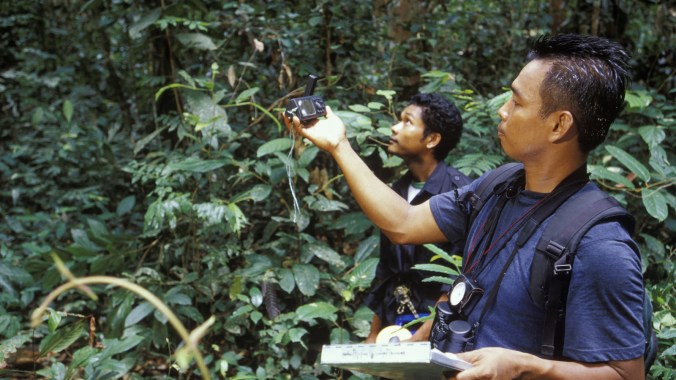
TNC’s Nardiyono, Team Leader of the Orangtuan Nest Survey, uses GPS to plot location during survey work.
The survey also found 4 million hectares of additional habitat that had not been identified in previous habitat assessments. It also determined that a staggering 78 percent of the orangutan population in Kalimantan lives outside protected areas.
A pessimist could look at this and see an orangutan population at even higher risk than thought. How can orangutans survive if most of them live outside of parks and preserves? But Conservancy conservationists saw this as an opportunity – an opportunity to work with the villages and companies that have the potential to sustain orangutan populations.
One of the chief tools is Forest Stewardship Council (FSC) certification. FSC involves a rigorous certification process that ensures forestry practices meet the highest international environmental, social and economic standards. When consumers see the FSC label, they know they’re purchasing wood products that did not destroy the rainforest. That did not imperil orangutans.
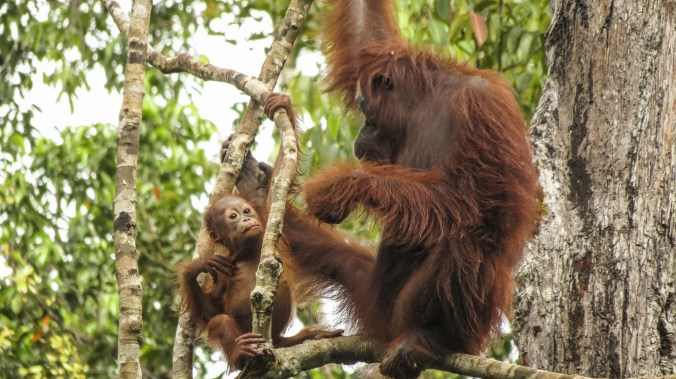
An orangutan and baby in Tanjung Puting National Park.
Working with companies to attain forestry certifications, like FSC, is one part of a broad, deep effort to conserve orangutans. The Conservancy is also working with forestry companies to test and implement land management practices that lessen impacts to forest habitat and reduce carbon emissions while maintaining profits. Conservationists also work with these companies to develop practices to conserve orangutans so that the large landscape outside protected areas can continue to provide a home for orangutans.
Of course, local communities – as has been the case for millennia – remain key to protecting these animals. They are the people who know orangutans best and also who come into conflict with them. The Conservancy engages community members by increasing their awareness, engaging them in monitoring of orangutans and providing capacity building to deal with orangutans.
It’s a comprehensive effort aimed at working with all those who live and work in orangutan habitat. The goal – to maintain viable habitat for orangutans over at least 1.5 million hectares – is ambitious. While much of the press lately around orangutans has been dismal, these efforts offer hope for all who want to conserve Borneo’s great ape.
Read the full article at Cool Green Science here.
 Organikos
I’m ” Laurent Outan ” …!!!
I’m surprised that the issue of Palm Oil was not mentioned as this is a direct threat to their habitat & welfare; & not only orangutans but all wildlife that calls the rainforest home. Palm oil is in just about everything. It is vital to read labels and avoid Palm oil or at least ensure it’s sustainably sourced. Check my page for more ways you can help: https://awarenesshelps.wordpress.com/palm-oil/
Thank you for bringing it up, I will check out your page