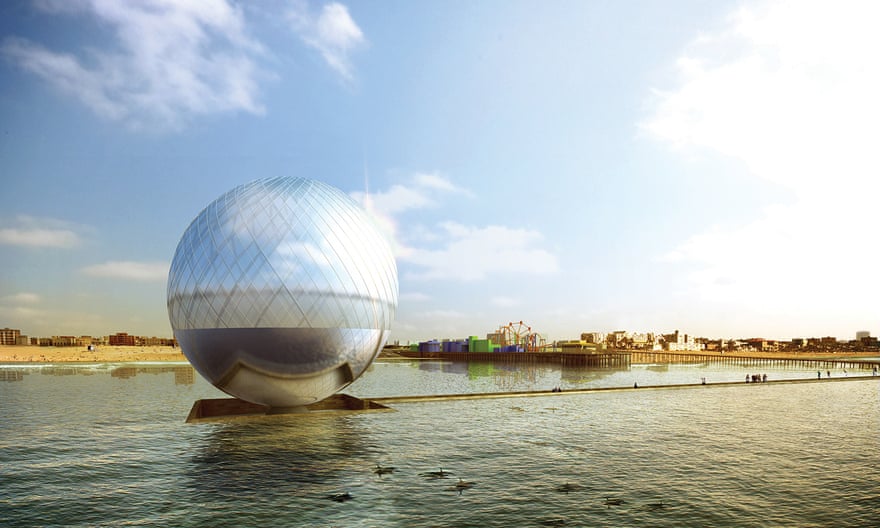
The Clear Orb is a proposed glass desalination dome 40 meters in diameter, lined with solar cells to generate power to pump seawater. Inside the orb, the sun’s heat would distill the saltwater through evaporation and condensation. The project could generate 3,820 megawatt hours of electricity and 2.2m liters of fresh water a year. The underbelly of the orb is covered in fins that can turn wave action into electricity. Artists: Jaesik Lim, Ahyoung Lee, Jaeyeol Kim, Taegu Lim from Seoul, South Korea.
Photograph: Land Art Generator Initiative
In recent months we’ve seen some interesting competitions blending technology with art and aiming to improve the world in some way, like lionfish hunting, wildlife crime controlling, and milk tea brewing. But a biennial public art contest organized by the Land Art Generator Initiative, featured last week in The Guardian, might be the most impactful in terms of scale and long-term inspiration – although the anti-poaching stuff is pretty good too. Alison Moodie writes (and make sure to follow her first link!):
These ideas illustrate the possibility of marrying aesthetics with renewable energy and water technology and educate the public about the challenges of addressing climate change and feeding a growing population.
Santa Monica, a beach town west of Los Angeles, is the setting for this year’s competition. The theme is clean water, to acknowledge California’s fifth year of serious drought. The winners will be announced on 6 October.
Cash prizes are $15,000 for first place and $4,000 for second place. While winning doesn’t guarantee that the concept will be brought to life, LAGI works with city governments and local businesses to try and turn the more feasible projects into reality.
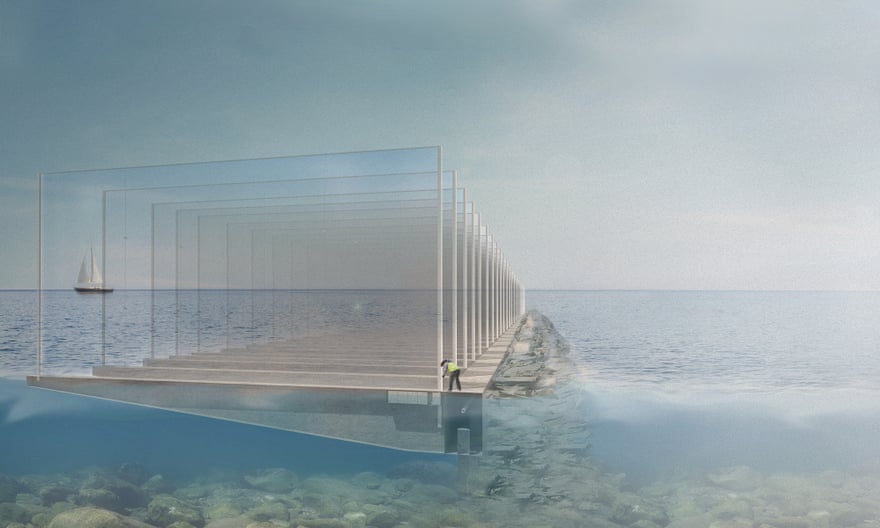
Horizon Lines materializes as a series of proposed giant solar panels with coatings that turn them transparent. They would be anchored in the ocean and mimic the crest and break of a wave. Each panel would come with an LED light that shines in varying brightness to reflect the amount of energy produced. The design is a nod to a sewage pipe that used to run below the pier, emptying waste into the ocean. It would produce 625 megawatt hours of electricity each year. Artists: Rebecca Borowiecki from Boulder, Colorado.
Photograph: Land Art Generator Initiative
See the original article here, and don’t forget to visit the LAGI website, where “renewable energy can be beautiful.“
 Organikos