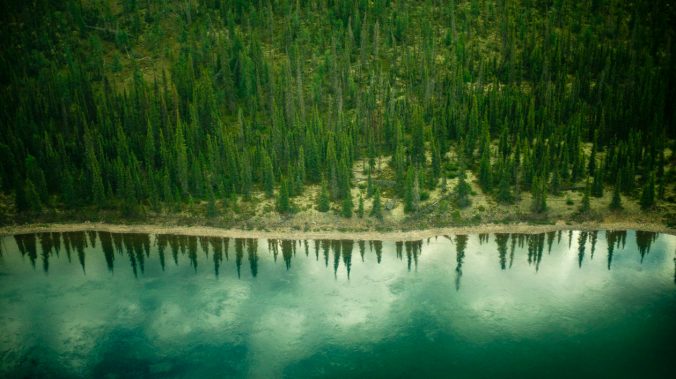
Aerial view of the Thelon River and forest landscape of Canada’s far northern Thelon Game Sanctuary. The refuge is the largest and most remote game sanctuary in North America. For the Akaitcho Dene people, the Upper Thelon River is “the place where God began.” In 2011 The Nature Conservancy’s lead scientist Sanjayan and Canada program director Dr. Richard Jeo went on an expedition through through this pristine area with young members of the Dene First Nation. They traveled by canoe along the Thelon River ending in North America’s largest and most remote wildlife refuge, the Thelon Game Sanctuary. This photograph is from that trip. PHOTO CREDIT: © Ami Vitale
Thanks to Cool Green Science, the conservation science blog of The Nature Conservancy, for this sobering update on the state of affairs of meeting conservation targets (um, those related to whether or not this planet will be one our future generations will be able to live on):
Global Wilderness Areas in Decline Despite Conservation Targets
BY JUSTINE E. HAUSHEER
Conservation today operates in a world of targets: Protect 17 percent of terrestrial systems and 10 percent of marine systems by 2020; keep global climate change below 1.5 degrees Celsius by 2100; halve the rate of natural habitat loss.
But despite widespread adoption of protected area targets, wilderness areas are still declining rapidly across the globe. Now, new research shows that 9.6 percent of all global wilderness has disappeared in the last 20 years.
Large, Intact, and Endangered
Wilderness. It’s a loaded term, and one that means different things in different contexts. But all definitions share the common link that wilderness areas are large, biologically and ecologically intact landscapes that are free from human disturbance. Place like like Canada’s vast boreal forests or Australia’s red deserts. These areas are not entirely without people — many are home to indigenous communities — but they are free from large scale disturbance like industrial activities, infrastructure, and commercial agriculture.
Because they are large, intact systems, wilderness offers significant benefits beyond the existence value of natural spaces. Research shows that wilderness areas are more resilient to climate change, sequester twice as much carbon as degraded landscapes, act as species refugia, and help stabilize local weather patterns.
But how much wilderness remains on earth, and how well are we protecting it.
Mapping the World’s Wilderness
To answer these questions, James Watson, based at the University of Queensland and director of science and research at the Wildlife Conservation Society, set out to measure how the world’s wilderness has changed in the past two decades.
Watson and his colleagues first revised a map of the global human footprint, incorporating other sources of non-satellite data like roads and pasturelands, to identify where natural systems are under pressure from human activities.
“Then we reversed the map, focusing in on the areas where there is little or no presence of humanity” says Watson. The researchers then used Google Earth to ground-truth their analysis, examining 3,000 points across the globe to confirm that they had accurately mapped a presence or absence of human activity…
Read the whole story here.
 Organikos