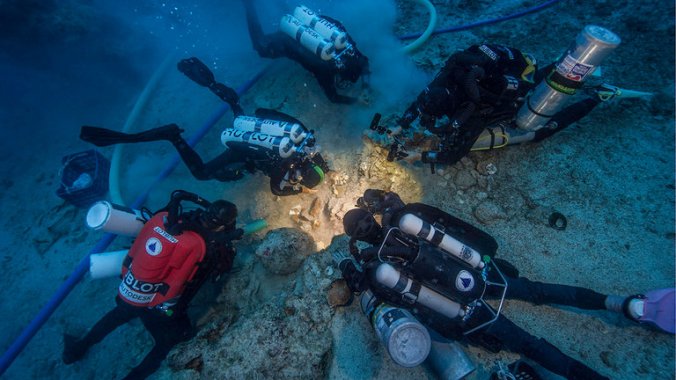
Divers and archaeologists excavating the 2,000 year old Antikythera shipwreck. Credit Brett Seymour/EUA-WHOI, via Argo
This story, about remains recently found under water in a region of the Greek islands where several of us at La Paz Group have very fond memories of, gives me pause. At the time the ship in this story wrecked, the Mayans in Belize were flourishing. The archeologists working at Chan Chich Lodge are still dating the structures there, but the sailor from the ship lost in Antikytheran waters would likely have found the Mayans quite advanced relative to his own culture.
Greece’s classical period was long over by the time this sailor lost his life, and Rome’s empire was still expanding, impressively. Lots of progress, civilization-wise, philosophy-wise, math-wise, geometry-wise in that Mediterranean zone; but also in what is now called Belize, and the wider Mesoamerican corridor. Reading this article, I appreciate the work of archeologists who advance our understanding of those who came before us:
Human Remains Found at Ancient Roman-Era Shipwreck
By
Underwater archaeologists have found a 2,000-year-old skeleton belonging to a victim of the famed Antikythera shipwreck from ancient Roman times.
The bones are the latest prize from a treasure trove that has yielded bronze statues, marble sculptures and, most famously, the Antikythera mechanism, a clocklike device thought to be the world’s oldest analog computer.
Since its discovery in 1900 by sponge divers, the Antikythera shipwreck has provided archaeologists with a window into the trading practices and culture of the ancient Mediterranean by the recovery of jewelry and trinkets. Now, if the researchers can collect genetic information from the human remains, they will gain their best insight yet into the lives of the people who perished on the vessel in 65 B.C.
“We knew this was the find of the decade in terms of underwater archaeology,” said Brendan Foley, a research specialist at Woods Hole Oceanographic Institute who helped uncover the bones. “We’re hoping that by the end of this year we’ll have the first DNA results from an ancient shipwreck victim.”…
 Organikos