We are human, therefore we love cute kitten videos just like the next person. We just do not need to share them here. That is not our purpose. Ditto for puppy dog videos, though we have a soft spot for scientific explanation for how dog became man’s best friend. Especially when creatively oriented to non-scientists. Back to cats. We have been featuring them as often as possible here, when considered relevant. And then some links for good measure. Our thanks now to Nature, which brings scientific studies within reach of a motivated lay audience, for this story on one path by which cats came to their current prominent state of domestication in our lives:
How cats conquered the world (and a few Viking ships)
First large-scale study of ancient feline DNA charts domestication in Near East and Egypt and the global spread of house cats.
Ewen Callaway
Thousands of years before cats came to dominate Internet culture, they swept through ancient Eurasia and Africa carried by early farmers, ancient mariners and even Vikings, finds the first large-scale look at ancient-cat DNA.
The study, presented at a conference on 15 September, sequenced DNA from more than 200 cats that lived between about 15,000 years ago and the eighteenth century ad.
Researchers know little about cat domestication, and there is active debate over whether the house cat (Felis silvestris) is truly a domestic animal — that is, its behaviour and anatomy are clearly distinct from those of wild relatives. “We don’t know the history of ancient cats. We do not know their origin, we don’t know how their dispersal occurred,” says Eva-Maria Geigl, an evolutionary geneticist at the Institut Jacques Monod in Paris. She presented the study at the 7thInternational Symposium on Biomolecular Archaeology in Oxford, UK, along with colleagues Claudio Ottoni and Thierry Grange.
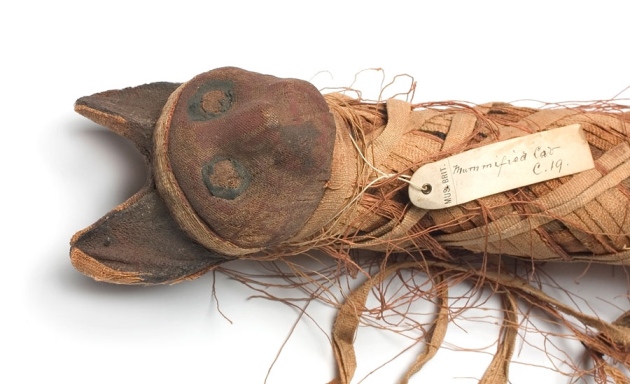
A 9,500-year-old human burial from Cyprus also contained the remains of a cat1. This suggests that the affiliation between people and felines dates at least as far back as the dawn of agriculture, which occurred in the nearby Fertile Crescent beginning around 12,000 years ago. Ancient Egyptians may have tamed wild cats some 6,000 years ago2, and under later Egyptian dynasties, cats were mummified by the million. One of the few previous studies3 of ancient-cat genetics involved mitochondrial DNA (which, contrary to most nuclear DNA, is inherited through the maternal line only) for just three mummified Egyptian cats.
Feline travels
Geigl’s team built on those insights, but expanded the approach to a much larger scale. The researchers analysed mitochondrial DNA from the remains of 209 cats from more than 30 archaeological sites across Europe, the Middle East and Africa. The samples dated from the Mesolithic — the period just before the advent of agriculture, when humans lived as hunter–gatherers — up to the eighteenth century.
Cat populations seem to have grown in two waves, the authors found. Middle Eastern wild cats with a particular mitochondrial lineage expanded with early farming communities to the eastern Mediterranean. Geigl suggests that grain stockpiles associated with these early farming communities attracted rodents, which in turn drew wild cats. After seeing the benefit of having cats around, humans might have begun to tame these cats…
Read the whole story here.
 Organikos