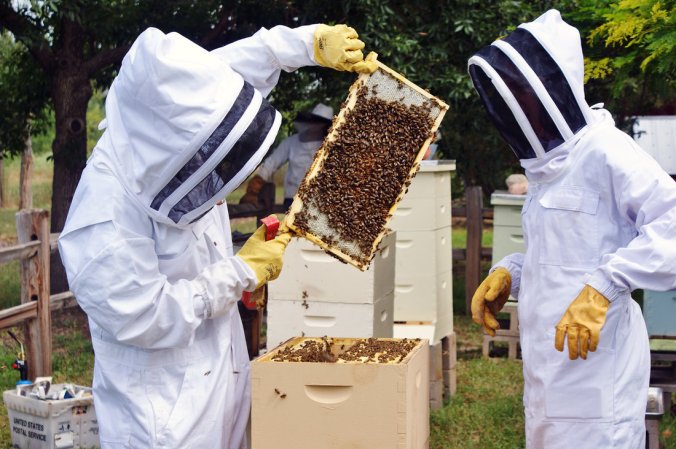
Beekeepers inspect bee frames at the Hudson Gardens community apiary near Littleton, Colo. Modeled after community gardens, community apiaries allow beekeepers to maintain hives in public spaces — and offer each tips and support. Courtesy of Hudson Gardens
We like what we have been learning about Hudson Gardens:
Beekeepers Benefit From The Hive Mind In Community Apiaries
JODI HELMER
Even though Marca Engman read countless books, watched YouTube videos and took a beekeeping class before installing her first hive in 2012, she knew she’d need help in the field.
“The whole idea of beekeeping was overwhelming,” she recalls. “Every year is different and every hive is different.”
Rather than working a backyard beehive solo, Engman installed her first hive in the community apiary at Hudson Gardens, a nonprofit garden near Littleton, Colo.
“Beekeeping in a community setting is less threatening, because you have support,” Engman says.
Community apiaries like the one at Hudson Gardens are generating a buzz. Modeled after community gardens, the sweet setups allow beekeepers to maintain hives in public spaces. Beekeepers generally pay a small fee to rent the space but own the equipment and manage the hives, keeping all of the harvested honey.
Although there are no official statistics on the number of community apiaries in the U.S., Tim Tucker, a beekeeper and immediate past president of the American Beekeeping Federation, has witnessed a significant uptick in the number of communities making it easier for residents to keep bees at home and in public spaces.
“Community beekeeping is a great idea,” he says.
Pittsburgh was home to the first community apiary. Burgh Bees opened the site in 2010, turning a once-neglected vacant lot in an urban neighborhood into an apiary for local beekeepers. It has grown to include 25 beehives and a thriving pollinator garden.
Read the whole story here.
 Organikos