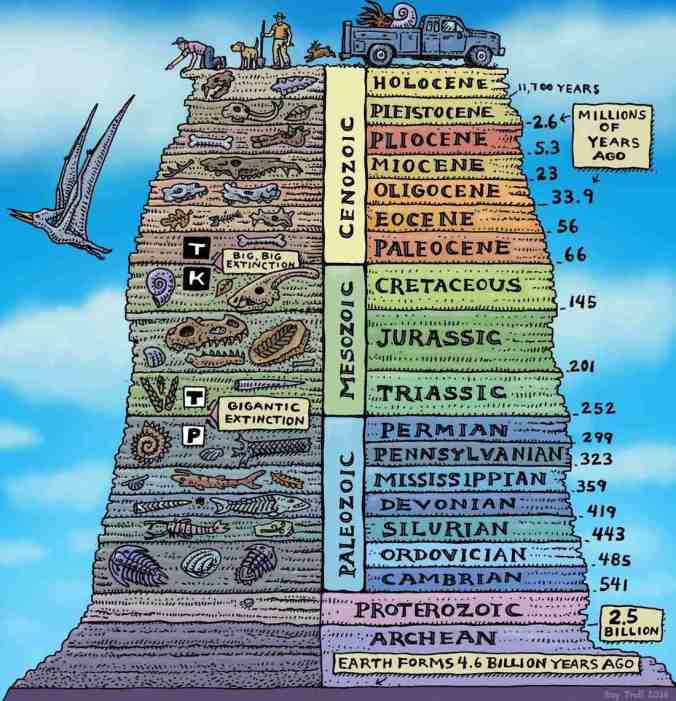
The Geologic History of Earth. Note the timescales. We are currently in the Holocene, which has been warm and moist and a great time to grow human civilization. But the activity of civilization is now pushing the planet into a new epoch which scientists call the Anthropocene. Ray Troll/Troll Art
Big words in the title may distract from the excellent point of this “cosmos & culture” article at National Public Radio (USA), worth a read:
Climate Change And The Astrobiology Of The Anthropocene
You can’t solve a problem until you understand it. When it comes to climate change, on a fundamental level we don’t really understand the problem.
For some time now, I’ve been writing about the need to broaden our thinking about climate. That includes our role in changing it — and the profound challenges those changes pose to our rightly cherished “project” of civilization.
Today, I want to sharpen the point.
But first, as always, let’s be clear: We have not gotten the science wrong. The Earth’s climate is changing because of human activity. That part has been well-established for awhile now, in spite of the never ending — and always depressing — faux “climate debate” we get in politics.
But the part of climate change we’ve failed to culturally metabolize is the meaning of what’s happening to us and the planet.
In other words, what we don’t get is the true planetary context of the planetary transformation human civilization is driving. Getting this context right is, I think, essential — and I’m dedicating most of the year to writing a book on the subject. The book’s focus is what I believe should be a new scientific (and philosophical) enterprise: the astrobiology of the Anthropocene.
I meet a lot of folks who’ve heard of both astrobiology and the Anthropocene before. In general, however, lots of people look at me a bit sideways when I use either word, much less lump them together as the future of humanity.
Given that experience, let’s start with a couple of definitions.
A trip to NASA’s astrobiology homepage will tell you the field is all about understanding life in its planetary context. It might seem strange to have an entire scientific domain dedicated to a subject for which we have just one example (i.e. life on Earth). But take that perspective and you’d miss the spectacular transformation astrobiology has brought to our understanding of life and its possibilities in the universe.
All those planets we’ve discovered orbiting other stars are part of astrobiological studies. The robot rovers rolling around Mars proving that the planet was once warm and wet — they are astrobiology, too. The same is true for work on Earth’s deep history. These studies show us that Earth has been many planets in its past: a potential water world before major continents grew; a totally glaciated snowball world; a hothouse jungle planet. In understanding these transformations, we’ve gotten to see one example of life and a planet co-evolving over billions of years.
If you want an example, consider how cyanobacteria, or blue-green algae, completely reworked the planet’s atmosphere 2.5 billion years ago giving us the oxygen-rich air we breathe today. Another example is the work showing how after the retreat of Ice Age glaciers, Earth entered a warm, wet and climatically stable period that geologists call the Holocene — about 10,000 years ago…
Read the whole article here.
 Organikos
Pingback: Perspective On The Ages — La Paz Group | Steal This Meme