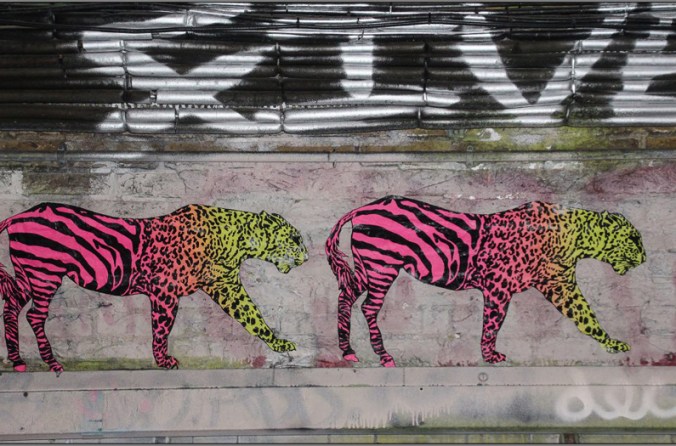
Header image: Street art in London by Aida. Credit: Maureen Barlin via Flickr.
Anthropocene is back, after a brief holiday break, with a good summary of findings on urban-influenced evolution:
Cities are the new laboratories of evolution
Cities are driving rapid evolutionary changes to plant and animal species, according to a study published yesterday in the Proceedings of the National Academy of Sciences.
Usually, we think of evolution as happening in remote, isolated, or pristine places—the Galapagos Islands, for example. But the new findings suggest that scientists can’t understand evolution as it’s currently occurring without grappling with the complex and expanding urban landscape…
…“Our study shows a clear urban signal; rates of phenotypic change are greater in urbanizing systems compared with natural and nonurban anthropogenic systems,” the researchers write.
Interactions with humans, such as selective harvesting of a medicinal plant, and the introduction of new predator, prey, and competitor species also spur evolutionary change.
And cities are the sites of novel evolutionary pressures, such as high concentrations of zinc around electrical transmission towers that have resulted in the development of zinc tolerance in certain plants…
…In other words, by building cities we’re also driving evolutionary changes that could affect the sustainability of those cities down the line. That means studying the evolutionary effects of urbanization isn’t just necessary to understand evolution in some abstract sense—the future of our own species may also depend on it.
Source: Alberti M et al. “Global urban signatures of phenotypic change in animal and plant populations.” Proceedings of the National Academy of Sciences. 2017.
Read the whole summary here.
 Organikos