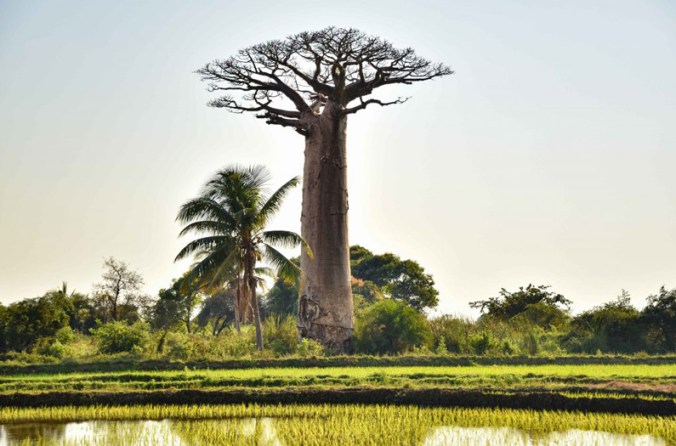
Baobab and palm tree/Rod Waddington via Flickr
Thanks to Anthropocene for this summary:
Trees improve the environment—and bottom line—on small African farms
by Emma Bryce
On thousands of rural farms spread across sub-Saharan Africa, farmers have been benefiting from a secret source of income that’s hiding in plain sight: trees. Writing in the journal Forest Policy and Economics, researchers from the University of Illinois have discovered that alongside conventional crops and livestock, trees boost rural farmers’ income by almost 20 percent in some African countries.:
Historically, the value of farmland trees has been overlooked. Trees are usually large and slow-growing, so they’re not counted as ‘crops’ in the conventional sense; individually, they don’t really count as ‘forest’, either. So when land use is measured, farmland trees typically “fall through the cracks,” says Daniel Miller, who researches environmental politics and policy at the University of Illinois, and is an author on the new paper. To remedy this, he and his team set out to quantify the value of trees on smallholder farms—the tiny plots of land, usually owned by families, that produce the bulk of Africa’s food…
…This and other factors need to be studied in more detail, if we are to grasp the full potential of farmland trees, say Miller and colleagues. “Overall, the results suggest that trees on farms should be given more attention in agriculture, food security and poverty-related policy debates in Africa,” they write in their paper, “particularly as the need to tackle climate change becomes more urgent.”
Source: Miller et al “Prevalence, economic contribution, and determinants of trees on farms across Sub-Saharan Africa.” Forest Policy and Economics. 2017.
Read the whole summary here.
 Organikos