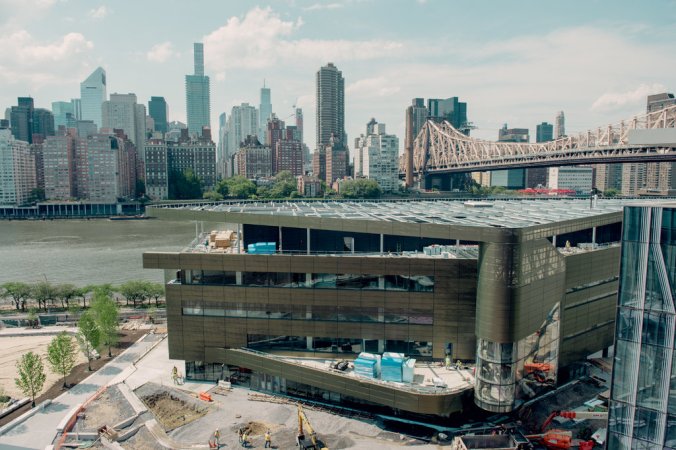
A view of Manhattan from the roof of the Bridge building on the Cornell Tech campus on Roosevelt Island. Photo VINCENT TULLO
When Cornell University competed in 2011 to develop an applied science and engineering campus in New York City, part of its pitch was that it would construct an academic building that would at least approach making as much energy as it used in a year, a concept known as net zero. It won. Then came the hard work of making that vision happen at the campus, known as Cornell Tech.
The first step: Architects from Morphosis designed the building, on Roosevelt Island in the East River, to use as little energy as possible. The second was making enough electricity to cover that reduced load without natural gas, part of its effort to stem climate change.
So the four-story building, the Bloomberg Center, is squat, with a roof larger than the body, to maximize space for solar panels. When it is complete in September, 1,464 solar panels will span the roof.
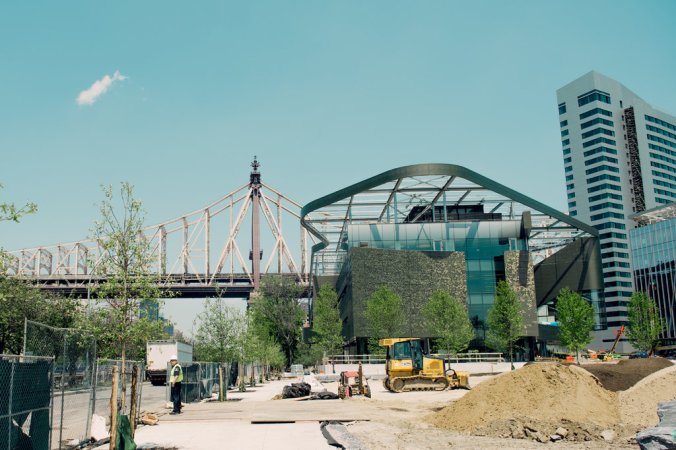
The Bloomberg Center, the first academic building to open on the Cornell Tech campus, will be topped with 1,464 solar panels.
Designers created an image of the Manhattan skyline on the west side, visible from the tram connecting the island with Manhattan, and an image of a gorge in Ithaca, N.Y., where Cornell is based, on the east side.
In the basement of the center, a geothermal heating and cooling system will connect to 80 wells drilled 400 feet beneath the dirt field, reducing the need for electricity. The field will eventually become a grassy public open space. A 40,000-gallon underground tank will collect rainwater for use in plumbing, cooling and irrigation systems. Wrapped around the thick-walled sides of the center, a perforated aluminum skin will act as both shade and insulation…
Read the whole story here.
 Organikos