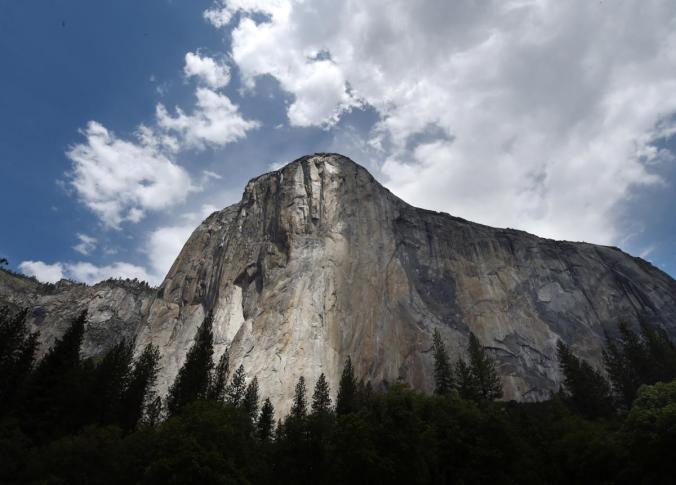
El Capitan, the towering stone heart of Yosemite National Park and a sweep of golden granite reaching twenty-seven hundred feet into the sky. PHOTOGRAPH BY MARK RALSTON / AFP / GETTY
I am not a climber and I do not generally favor extreme sports where someone else has to come in and clean up after an adventurer’s misfortune. I am in awe in this case, and so make an exception. It never bores me to look again at the image above. But it electrifies me more than usual when it accompanies a story like this one:
…Four hours later, that lone figure, the thirty-one-year-old professional climber Alex Honnold, had completed the first ascent of El Cap in the free-solo style. In other words, he had climbed the cliff alone and without a rope or protective equipment of any kind. Had he fallen, he would have died.
The achievement had long been predicted but never quite accepted as possible. The iconic face of El Capitan—photographed by Ansel Adams, praised by John Muir as “the most sublime feature of the Valley”—has long been the proving ground for American rock climbing. It has been climbed at incredible speeds and via routes of extraordinary difficulty; a ropeless ascent was the last “big psychological breakthrough” that remained, as Peter Croft, who completed groundbreaking free solos in the nineteen-eighties and nineties, put it. There was no real competition to be the first to meet the challenge. Either Honnold would do it, or he would leave it to future generations. Or he would try, fail, and fall…
A sports writer for the New York Times titles it perfectly:
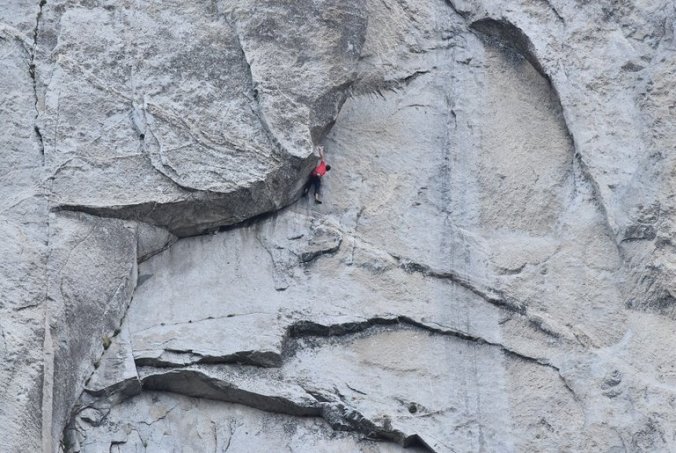
Alex Honnold at the 1,000-foot level of his free-solo climb of El Capitan. CreditTom Evans
El Capitan, My El Capitan
Alex Honnold woke up in his Dodge van last Saturday morning, drove into Yosemite Valley ahead of the soul-destroying traffic and walked up to the sheer, smooth and stupendously massive 3,000-foot golden escarpment known as El Capitan, the most important cliff on earth for rock climbers…
 Organikos