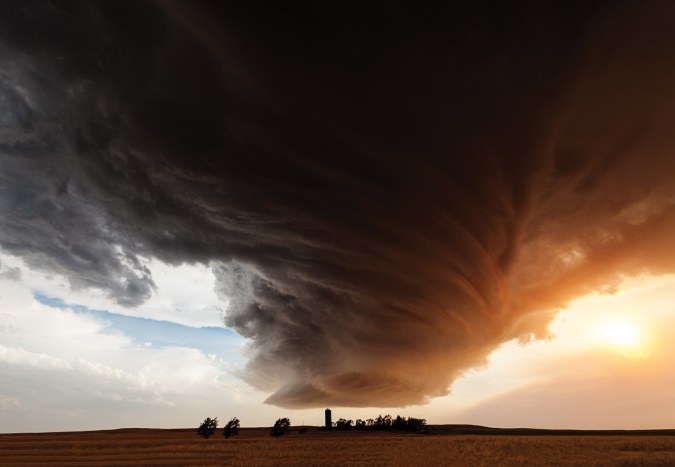
Nebraska, June, 2012.
Just because the climate is changing at a pace both dangerous and seemingly impossible to slow, given human tendencies; just because the storms that come from clouds can cause fear and worse; none of that diminishes our wonder and our ability to see importance in those clouds:
A Storm Chaser’s Unforgiving View of the Sky
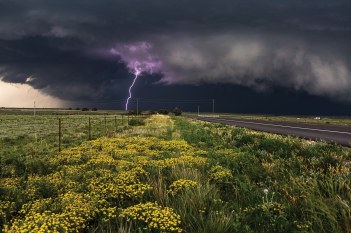
Texas, June, 2014.
By Alan Burdick
Photography by Camille Seaman
A cloud is a shade in motion. Shape-shifting and moody, it arrives with a message that is opaque as often as it is threatening. “Clouds always tell a true story,” the Scottish meteorologist Ralph Abercromby wrote, in 1887, “but one which is difficult to read.”
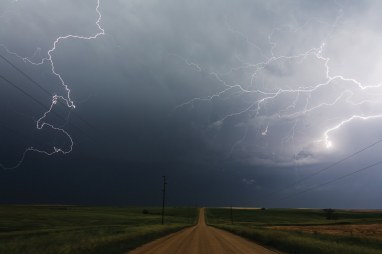
Kansas, June, 2008.
The appeal of clouds is obvious: no two are the same, and no one is the same for long. And they not only manifest change but inflict it as well. A cloud can be beautiful, terrible, or both—the embodiment of the sublime. Few other things on earth still present us with a power larger than ourselves. To watch a supercell gather force over the plains, as storm chasers take such pleasure in doing, is to watch Zeus take shape on earth.We’ve learned enough over the centuries to know that clouds aren’t supernatural; rather, fiercely condensed and sweeping, they represent all that is natural, and we stand beneath them awed and merely human.
But our relationship to clouds is changing, growing hazy. In 1803, Luke Howard, a British pharmacist, proposed a classification scheme that has mostly stayed with us. It introduced four basic kinds of clouds—cirrus, stratus, cumulus, and nimbus (the Latin words for curl, layer, mass, and rain)—as well as an array of subcategories that recognized the fact that one kind of cloud could turn into another. Recently, meteorologists have added several new cloud types to that known pantheon, and some of them describe clouds that are created by us: Cumulus homogenitus names the cloud formation produced by smokestacks and steam plants; Cirrus homomutatus are the high-elevation condensation trails produced by airplanes…
 Organikos