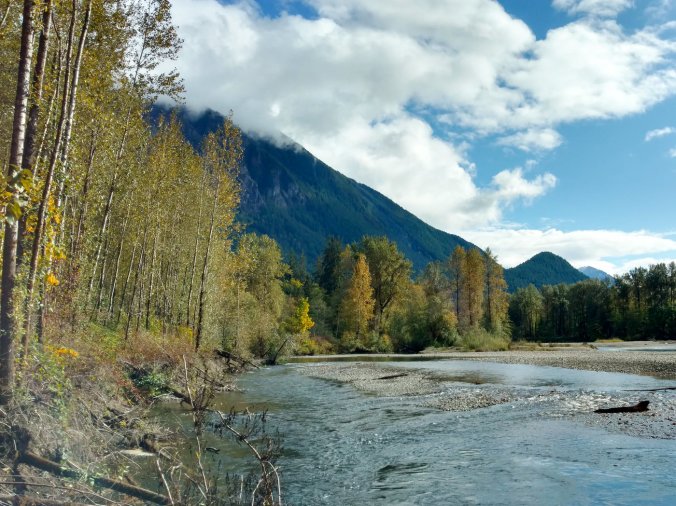
Poplar trees at the Snoqualmie River in Washington State. The river is fed mostly by snow melt and is extremely low in nitrogen, yet the trees thrive thanks to endophytes. Sharon Doty
Thanks to our friends at the salt, and National Public Radio (USA) for this:
Microbial Magic Could Help Slash Your Dinner’s Carbon Footprint
Endophytes are microbes that live inside plants — the ones tagged with a fluorescent dye in this image are found in poplars. The microbes gather nitrogen from the air, turning it into a form plants can use, a process called nitrogen fixation. Researchers are looking at how these microbes could be used to help crops like rice and corn make their own fertilizer.
Sam ScharffenbergerIf you’re interested in sustainability, you’ve probably thought about how to reduce your carbon footprint, from how you fuel your car to how you heat your home. But what about carbon emissions from growing the food you eat?
Most of the crops in the United States are grown using chemical fertilizer – a lot of it: American farmers used over 24 billion pounds of nitrogen fertilizer in 2011. And making nitrogen fertilizer requires fossil fuels like natural gas or coal.
In a single year, production of fertilizer in the United States emitted as much carbon dioxide as two million cars. But plants need nitrogen to survive, so farmers can’t just stop using fertilizer. Without it, U.S. crop yields would fall by as much as 50 percent, according to some estimates.
What if we could help plants make their own nitrogen so they wouldn’t need manmade chemical fertilizers? Professor Sharon Doty, a plant microbiologist at the University of Washington, says nature has already figured out this problem — we just have to know where to look.
“Look outside,” she says. “Go to a natural environment and there are many cases where you can see plants that are thriving in rocks and sand – very nitrogen-poor environments.”
Doty started by looking at willow and poplar trees living in river systems in Washington state. These rivers are fed mostly by snow melt and are extremely low in nitrogen. “It’s long been known that poplar and willow are pioneer species,” Doty says. “But [other scientists] say, ‘Oh, they’re just really efficient.’ But there’s nothing to be efficient with! There’s nothing there!”…

Read the whole article here.
 Organikos