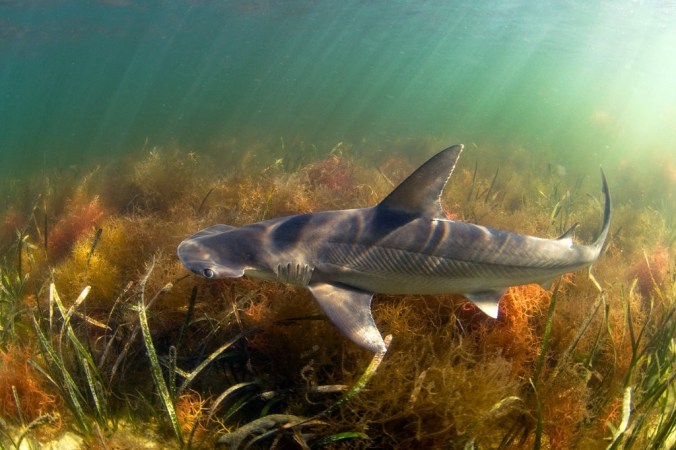
A bonnethead shark in the shallows of Florida’s Pine Island Sound. Credit Getty Images
I do not know why it has been so long since we last linked to a story by her, and I will remain on the lookout for more excellent science writing by her, but for now a quick thanks to Veronique Greenwood for this:
The Omnivorous Sharks That Eat Grass
Diminutive bonnethead sharks are the first omnivorous sharks known to science, which could change our understanding of what some sharks eat.
After researchers caught bonnethead sharks for study, they received a daily meal consisting of a wad of seagrass wrapped in a piece of squid, resembling a large inside-out sushi roll. Credit Samantha Leigh
Sharks are not known for their taste for greenery. But at least one species of shark enjoys a salad of sea grass as well as the prey it hunts.
The bonnethead shark, a diminutive species that reaches up to 3 feet in length, lives in the shallow sea grass meadows off both coasts of the Americas. It eats small squid and crustaceans ferreted from the swaying underwater fronds. But, researchers who have carefully monitored everything going in and out of captive bonnetheads say in a study published in Proceedings of the Royal Society B that they also eat large quantities of seagrass. The grass isn’t just passing inertly through the sharks’ guts. They extract nutrition from it just as they do from the meaty portion of their diet. These sharks must, therefore, be reclassified as omnivores — the first omnivorous sharks known to science.
In 2007, researchers first reported that the digestive tracts of bonnethead sharks caught in the Gulf of Mexico were full of sea grass, up to 62 percent of the contents by weight.
At the time, some reasoned that the grass might have been ingested incidentally, as the sharks dove for scurrying prey in the meadows. But Samantha Leigh, a graduate student at the University of California, Irvine, and lead author of the paper, and her colleagues wondered whether there was more to it.
They caught bonnethead sharks just off the Florida Keys and transported them to an outdoor lab facility. There, the sharks lived in a large tank and received a meal every day consisting of a wad of seagrass wrapped in a piece of squid, resembling a large inside-out sushi roll. The sea grass, which made up 90 percent of the roll, had been loaded with a tracker isotope that could be detected later in their blood if the grass was truly being digested, not just passing through. The researchers also filtered the sharks’ feces from the water using a fine mesh, allowing them to test how much of what went in came out.

Read the whole story here.
 Organikos