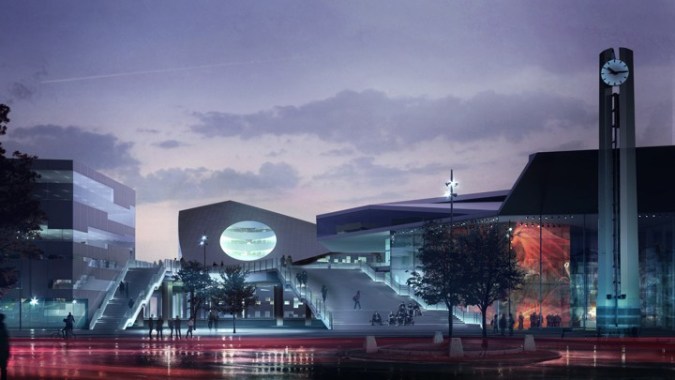
A rending of Powerhouse Brattørkaia, an “energy-positive” building that will open to the public next year in Norway SNØHETTA
Thank you Norway, for demonstrating that we can do better than neutrality:
Norway Is Entering a New Era of Climate-Conscious Architecture
The country now has a suite of buildings that generate more energy than they use.
The European Union has a target of making all new buildings zero-energy by 2020, but in Norway, carbon neutrality isn’t enough.
A consortium in Oslo made up of architects, engineers, environmentalists, and designers is creating energy-positive buildings in a country with some of the coldest and darkest winters on Earth. “If you can make it in Norway, you can make it anywhere,” says Peter Bernhard, a consultant with Asplan Viak, one of the Powerhouse alliance members.Bernhard says Powerhouse began in 2010 with a question: Is it possible to not only eliminate the carbon footprint of buildings, but also use them as a climate-crisis solution? It was a lofty goal. According to the European Commission, buildings account for 40 percent of energy usage and 36 percent of CO2 emissions in the EU.
But after undertaking several energy-positive projects—building a new Montessori school, retrofitting four small office buildings, building a few homes, and breaking ground on two new office buildings—Powerhouse has found the answer to the 2010 question to be an emphatic “yes.”
In 2019, the collective’s biggest project to date will be opened to the public: Powerhouse Brattørkaia, in the central Norwegian city of Trondheim.
Brattørkaia is an eight-story office building that will produce 485,000 kWh annually. For reference, the average Norwegian home uses about 20,000 kWh of power a year. (In the United States, the yearly household average is 10,399 kWh). Brattørkaia will, in effect, become a mini-power plant that can supply electricity to Norway’s publicly owned grid.
Its surplus energy will also compensate for the power used to produce its building materials. That, says Snøhetta architect Jette Hopp, is unique; prevailing definitions for energy-positive buildings don’t include materials’ embodied energy…
Read the whole story here.
 Organikos