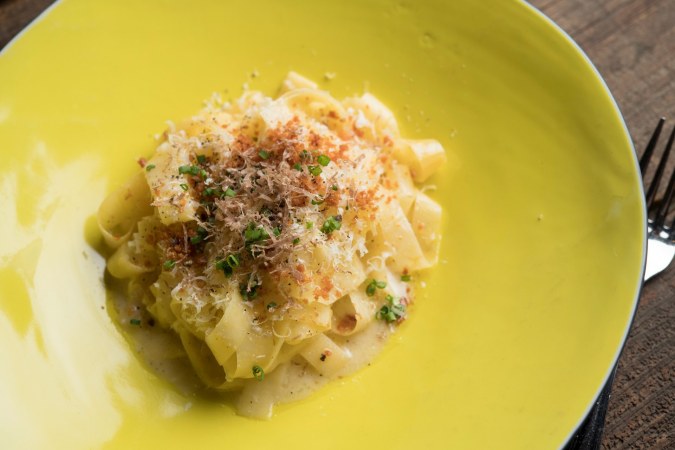
Rutabaga tagliatelle, from Olmstead, in Brooklyn.Photograph by Evan Sung
In the interest of cutting back meat consumption, my eye is easily caught these days by pretty shiny things, like the image above, but even more so by rich description, especially when the history of a food is illuminated. This brief history of one root vegetable, accompanied by a couple of beautiful photos, led me to the book below right. Click the book image to go to the source. 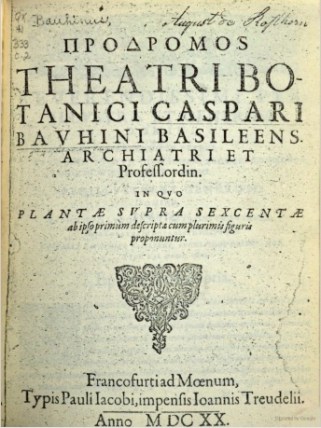
The original is in a collection akin to the one where Seth did his History honors thesis, and akin to the one where some of my doctoral dissertation‘s historic data was sourced (if you are a Cornell geek or library geek scroll upward from the cover page to see the details). Thanks to Helen Rosner once again brilliantly for getting me exploring:
The Swiss botanist Gaspard Bauhin was born in Basel in 1560, and he dedicated his life to obsessively cataloguing the vegetable world. To present-day historians, he’s notable primarily for his botanical thesaurus “Pinax Theatri Botanici” (“An Illustrated Exposition of Plants”), published in 1623. But, among cooks, he’s sometimes recalled for his lesser work, published in 1620: “Prodromos Theatri Botanici” (“Prologue to the Exposition of Plants”), a compendium of flora in which he describes a plant with vivid yellow flowers, a spray of leaves, and massive, hairy roots “more or less similar to those of turnip or carrots.” It was a specimen that had never before appeared in any scientific list of plants: the rutabaga.
The rutabaga is a culinary underdog. It struggles to shine among its fellow root vegetables.Photograph by Matthias Haupt / Picture Press / Redux
The annals of botany abound with claims that Bauhin was not only rutabaga’s biographer but also its inventor: that he found it growing wild and domesticated it; that he was a civic-minded scientist seeking a cold-resistant turnip to feed his chilly countrymen and not (more likely) a monomaniacal scholar who spent his life ensconced in an herbarium, scrivening endless latinate lists of plant names. “The turnip is older than history,” the caption on a color plate in a 1949 issue of National Geographic declares. “The rutabaga almost modern.” In fact, the vegetable has been around at least since ancient-Roman times, when the naturalist Pliny the Elder, writing in the first century, described an edible root “between a radish and a rape”—meaning the plant from which rapeseed oil derives, which is a cultivar of the same species. Bauhin writes that in his time the vegetable was widely grown in “the cold Noric fields of Bohemia,” where it was eaten pickled or mashed and was called simply “root” by its cultivators.
“Rutabaga” comes from rotabagge, the plant’s Swedish name, meaning “baggy root.” This is, perhaps, the reason that it’s sometimes called a Swedish turnip or simply a swede. Dense and sweetly earthy, a spheroid that can grow to the size of a human head, with a mottled, brown-and-white surface and a buttery, yellow interior, the rutabaga looks like an overgrown turnip—which it is, sort of, at least on its mother’s side. A reproductive quirk of the Brassica genus allows for uncommonly easy hybridization (see the evidence in your local grocery store: kalettes, the frilly little greens that were 2014’s sexy new vegetable, are a cross between kale and Brussels sprouts). Somewhere, in the misty meadows of Central Europe, a turnip got frisky with a cabbage, and the rutabaga was born. This genetic history was confirmed only recently, in 1935, by the Korean-Japanese agricultural scientist Woo Jang-choon. But, three hundred years before, Bauhin, with his eye for botanical detail, saw to name the plant napobrassica, the turnip-cabbage.
Absolutely none of this historical ephemera is required to appreciate the rutabaga as a food. Though, to be honest, I’ve struggled through the years to find rutabaga’s particular strength among its fellow root vegetables. I buy it at the market on all sorts of pretexts: because I like these twists and turns of its etymological backstory; because of my fondness for the writer Carl Sandburg’s under appreciated fable cycle “Rootabaga Stories”; because I feel compelled by a stubborn sense of underdog solidarity to give a home to the less-loved, less-cool vegetables. There’s a moment of epiphany, for any cook, when she realizes that a certain ingredient performs a function better than absolutely anything else: carrots caramelize, artichokes hold a marinade, eggplants purée, shallots frizzle to a crisp. The rutabaga, however, is creamy enough to be made into a mash, but it’s no potato; it’s mild enough to be sliced paper-thin with a mandoline or vegetable peeler and eaten raw, but it’s no jicama; it makes a zingy, crisp pickle, but it’s no turnip. The writer Alicia Kennedy recently made the case for rutabaga as a substitute for meat, but that compelling proposition could also be made, just as neatly, for cauliflower. I wasn’t able to find its exceptionality. Was there anything that a rutabaga did best?
The answer, when I found it, was in my own back yard. Olmsted, a Brooklyn restaurant that’s just a few blocks from where I live, has an ever-changing menu, but one of their superstar dishes—almost always available—is a plate of tagliatelle drowning in an earthy brown-butter sauce with truffles. Except the pasta isn’t pasta; it’s a tangle of paper-thin ribbons of rutabaga, shaved to resemble noodles. When I asked Greg Baxtrom, the restaurant’s chef and co-owner, why rutabaga was the right vegetable for the job, his answer was simple. “It’s so big!” he said. “We can slice it into the right tagliatelle shape.” And, compared with the other big root vegetables, rutabaga is mild enough to let the sauce shine—“not like parsley root or celeriac,” Baxtrom said. “Its taste is clean.”…

Read the whole article here.
 Organikos