NEON
Honey, and bees, matter to us for reasons that might be obvious once you start searching our index for related posts on these topics since we started in 2011. Rarely, if ever, has a movie review appeared in our pages, but this one fits:
A Rare Nature Documentary That Tells a Deeply Human Story
Honeyland is both a personal tale about a lonely beekeeper in Macedonia and an epic with the aloof grandeur of Planet Earth
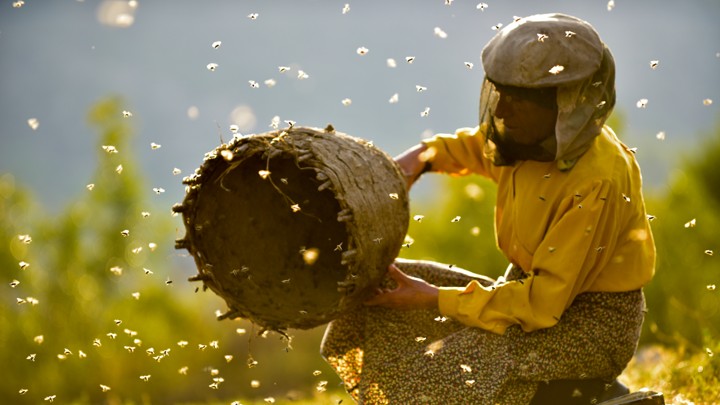
Honeyland is the story of an ecosystem. In its initial moments, Tamara Kotevska and Ljubomir Stefanov’s documentary about a rural beekeeper in the mountains of Macedonia seems like a singular, focused tale: a portrait of a woman performing a near-forgotten art. Indeed, the work that the protagonist, Hatidze, does, following ancient honey-harvesting traditions largely unknown to modern audiences, is fascinating enough. But this is the kind of nonfiction film that gets at much bigger truths about the tragic ways in which any environment, no matter how remote, can be thrown off balance by greed.
The first section of Kotevska and Stefanov’s documentary is extremely intimate. Hatidze, a Turkish immigrant in her 60s living in Macedonia, climbs up a mountain in a mostly uninhabited part of the country to collect honey from beehives that naturally form within the rocky outcrops. Exactly how the process works, or how she came to live in Macedonia, isn’t clear; the directors favor a naturalistic approach, letting little details slip out as Hatidze talks about her daily routine. But what could have been a simple exploration of agrarian bee harvesting turns into something bleaker, and more compelling, when a family moves in next door to Hatidze and tries to ramp up production.
Hatidze lives with her mother, a half-blind 86-year-old who barely leaves their dwelling. Kotevska and Stefanov’s camera captures the duo’s nighttime bickering with remarkable intimacy, as Hatidze’s mother frets that she’s a burden to her daughter while also rhapsodizing about her own longevity. “I’ve become like a tree. I’m not dying. I’m just making your life a misery. And I don’t intend to die. I eat bread, I drink water, I eat whatever I want,” she says. Much like the bees that nestle within the Macedonian mountains, Hatidze and her mother are a vital part of the local ecosystem, collecting half of the honey from the hives to sell and sustain themselves, but always leaving enough for the bees to keep their production cycle going.
Because Bekirijia, the region Hatidze lives in, is cut off from the nearest roads, the filmmakers could shoot for only a few days at a time before having to leave and restock their food and supplies. Despite this isolated existence, Hatidze’s careful routine is eventually shattered by the arrival of a family that has less respect for her way of life. At first, the appearance of Hussein Sam, his wife, and their seven kids is a salve for Hatidze’s loneliness; they’re new companions for her to talk with, who are more engaging than her mother. But while Hussein is interested in Hatidze’s business, he’s not swayed by her warnings that taking too much of the honey to sell at local markets will end up destroying the beehives; her rule of taking only half is ignored, and things begin to spiral into chaos…
Read the whole review here.
 Organikos