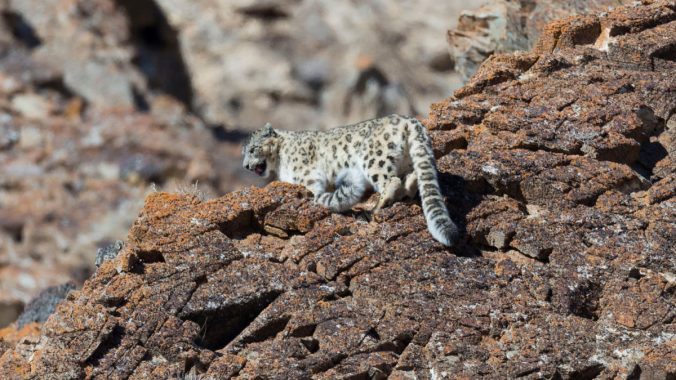
There are an estimated 1,000 snow leopards in Mongolia. HEMIS / ALAMY STOCK PHOTO
Our thanks to the activists who take on the cause of endangered wild cats around the world, and to Fred Pearce and Yale e360 for bringing them to our attention:
How a Mongolian Activist Is Helping Snow Leopards and Herders Coexist
Mongolian activist Bayarjargal Agvaantseren spearheaded the creation of the world’s first reserve for endangered snow leopards. In an e360 interview, she describes how she helped win over the local herders who once sought to kill the leopards but now patrol the reserve to protect them.
Bayarjargal Agvaantseren. GOLDMAN ENVIRONMENTAL PRIZE
Bayarjargal Agvaantseren has spent 20 years traveling to remote regions of Mongolia’s Gobi Desert, fighting to protect native snow leopards. The 50-year-old teacher-turned-activist persuaded Mongolia’s parliament in 2016 to create the world’s first national reserve specifically for the endangered animal. It links two existing protected areas to create a continuous safe zone for the species covering 31,000 square miles, where over a third of the country’s estimated 1,000 snow leopards live.
The creation of the reserve led to the banning of all mining in one of the animal’s key habitats. In a country so dependent on extractive industries — coal and minerals make up 85 percent of exports — her achievement is astounding. She attributes it to the support of remote goat-herding communities, people who she converted from regarding leopards as their enemies to patroling the reserve to protect them.
In April, Bayara’s work saving the snow leopards of Mongolia won her the Goldman Environment Prize, an annual award that honors grassroots environmental activists from six continents. In an interview with Yale Environment 360, Bayara talks about how she convinced indigenous communities to work with her, the major threats still facing snow leopards, and how after two decades working on their protection, she has yet to see the elusive mountain animal in the wild.
Yale Environment 360: How did your love affair with snow leopards start?
Bayarjargal Agvaantseren: I grew up in a small village in northern Mongolia, where my father was a teacher. After studying languages and literature in the capital Ulaanbaatar, I worked as a teacher and a translator for the leading American snow leopard researcher Tom McCarthy. For him, I interviewed herders in southern Mongolia about their attitudes to the leopards. I was hooked. They became my life’s work. In 2007, I created the Snow Leopard Conservation Foundation in Mongolia to carry on the research and expand community-based conservation.
e360: Snow leopards are known as the ghosts of the mountains. Tell us about them.
Agvaantseren: There are only between 4,500 and 7,000 of them left in the world, usually hiding and hunting in remote mountain regions of Asia. Mongolia has the second largest population in the world, after China, estimated at between 1,000 and 1,200. We think around a quarter of the Mongolian population lives in the mountains of the South Gobi region, close to the border with China. It is a critical habitat and migration route for the leopards, with one of the densest populations in the world.
Many [of the leopards] live in two national parks — the Gobi Gurvansaikhan National Park and Great Gobi, a Strictly Protected Area — where they find their main prey species like the Siberian ibex and argali, a wild mountain sheep. They are very elusive. In my 20 years of work in these remote areas, I haven’t yet seen one in the wild. But our radio collar studies show that they move around a lot. And some live in the mountain pastures between the parks, where they sometimes prey on the goat herds. This is where we created the new reserve…

Read the whole story here.
 Organikos